Every year, millions of patients put their trust in NHS services to diagnose and treat their injuries, illnesses and conditions. In the vast majority of cases, that trust is repaid with a good standard of care that helps patients resolve or manage their concerns.
But mistakes do happen. Standards can slip. And when they do, they can cause serious harm to patients, permanently change lives and irreparably damage people’s faith in healthcare professionals and services.
If you or someone you love is ever affected by these unfortunate circumstances, it is crucial that you know how to make an NHS medical negligence claim. It empowers you to pursue the compensation and answers you need to move on from what happened, with complete, long-term financial security.
This is what this guide will show you how to do. Based on my 30+ years of experience as a specialist medical negligence solicitor, below I will explain the steps to claim against the NHS, and answer frequent questions I receive from claimants about compensation, time limits, evidence and more.
First, it is important to define NHS medical negligence (aka NHS clinical negligence). As the phrasing suggests, NHS medical negligence is when the care provided by NHS medical professionals or organisations falls below an acceptable standard, and patients are harmed as a result.
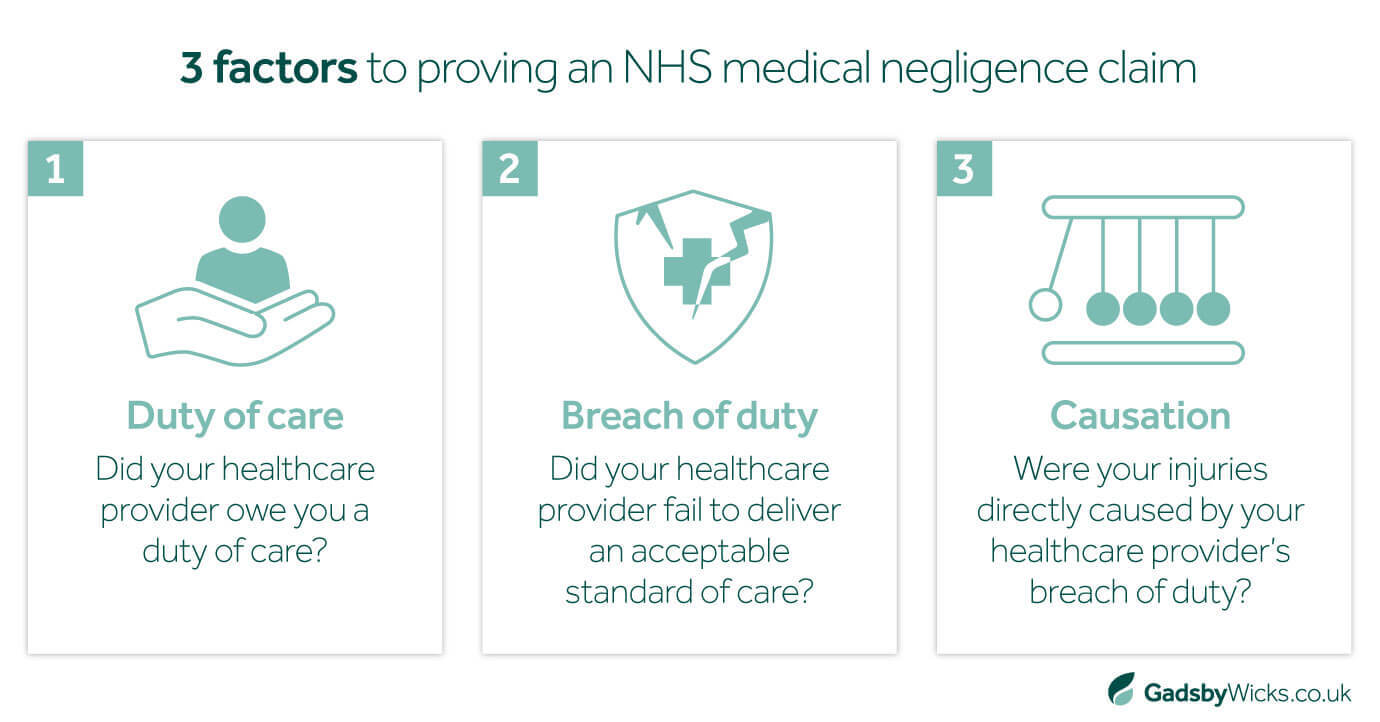
Establishing and proving NHS negligence is based on three fundamental pillars:
Duty of care
Every NHS medical professional and institution has a legally binding duty of care to any patient who comes to them for help or treatment. From the moment they accept responsibility for a patient, they are bound to treat them with an acceptable standard of care.
Breach of duty
The first aspect of proving medical negligence is determining if a medical professional breached their duty of care to their patient.
A healthcare professional breaches their duty of care if they fail to act in the way a reasonably competent doctor would. This could be neglecting to do something (e.g. not taking an accurate medical history), or acting incorrectly (e.g. prescribing the wrong medication).
Known as The Bolam Test, to prove a breach of duty, your solicitor must demonstrate that no other responsible body of doctors would regard a patient’s treatment as acceptable, or if there are, then it would not withstand logical analysis (Bolitho).
Causation
Once breach of duty is established, you must then prove that this was the direct cause of the patient’s injuries. This is known as causation.
It can often be challenging to prove causation, as in most cases the claimant will have already been injured or unwell before receiving treatment. Therefore, solicitors need to judge what would have happened to the patient if there had been no negligence, and if the actual outcome was any different.
This is judged on the “balance of probabilities”. This means you must prove that it was “more likely than not” that a healthcare professional’s breach of duty caused the patient’s injuries. You do not need to prove causation “beyond all reasonable doubt”.
Furthermore, a breach of duty does not need to be the only or main cause of a patient’s injury. You only need to prove that the breach of duty made a material contribution towards the injury.
Is any mistake considered NHS medical negligence?
While any mistake made by an NHS professional can be considered a breach of duty, it does not necessarily mean it was negligent. For example:
The patient had an atypical body structure, making mistakes during surgery or procedures more likely
The patient did not suffer any further injury, nor did their condition worsen due to the breach of duty
The mistake or error was something another reasonable doctor would have done in the same circumstances
The harm was a known, inherent risk of the procedure or condition, even with excellent care
An experienced medical negligence solicitor will be able to identify whether your case would be considered legally negligent or not.
As mentioned earlier, you can make a medical negligence claim against the NHS:
If the care and/or treatment you received fell below reasonable standards (breach of duty)
You suffered avoidable physical, psychological or financial harm, or your condition worsened
The harm you suffered was directly caused by the breach of duty
If you believe that this applies to you, you should contact a specialist solicitor to investigate and pursue your case.
Can I only make an NHS medical negligence claim against doctors and hospitals?
No, you can claim against any NHS healthcare professional or organisation that gives you negligent treatment, including:
Opticians
Dentists
Physiotherapists
Out-of-hours clinics
Midwives
Psychiatrists and mental health practitioners
Pharmacist
Be aware that you do not typically claim against the individual healthcare professional(s) responsible for your injuries, but the overall trust or Integrated Care Board (ICB) they represent.
Can I still access NHS care during my claim?
Yes, you are fully entitled to access NHS healthcare and treatment during a hospital negligence claim. You have a legal right to non-discriminatory care, and this should not be affected during the course of your claim.
Is making an NHS complaint the same as making a negligence claim?
No, making a complaint following inadequate treatment cannot secure compensation for your injuries and ongoing care.
Following the NHS complaints procedure can help you receive an explanation or apology for what happened to you, and may encourage improvements in healthcare standards. But if you want to receive compensation for your injuries, you must make a negligence claim.
Who handles NHS medical negligence claims?
The vast majority of NHS medical negligence claims are handled by NHS Resolution – the arms-length body of the UK Department of Health that manages negligence claims for its member organisations.
NHS Resolution is also responsible for paying compensation for successful claims, rather than the specific NHS trust involved in the claim.
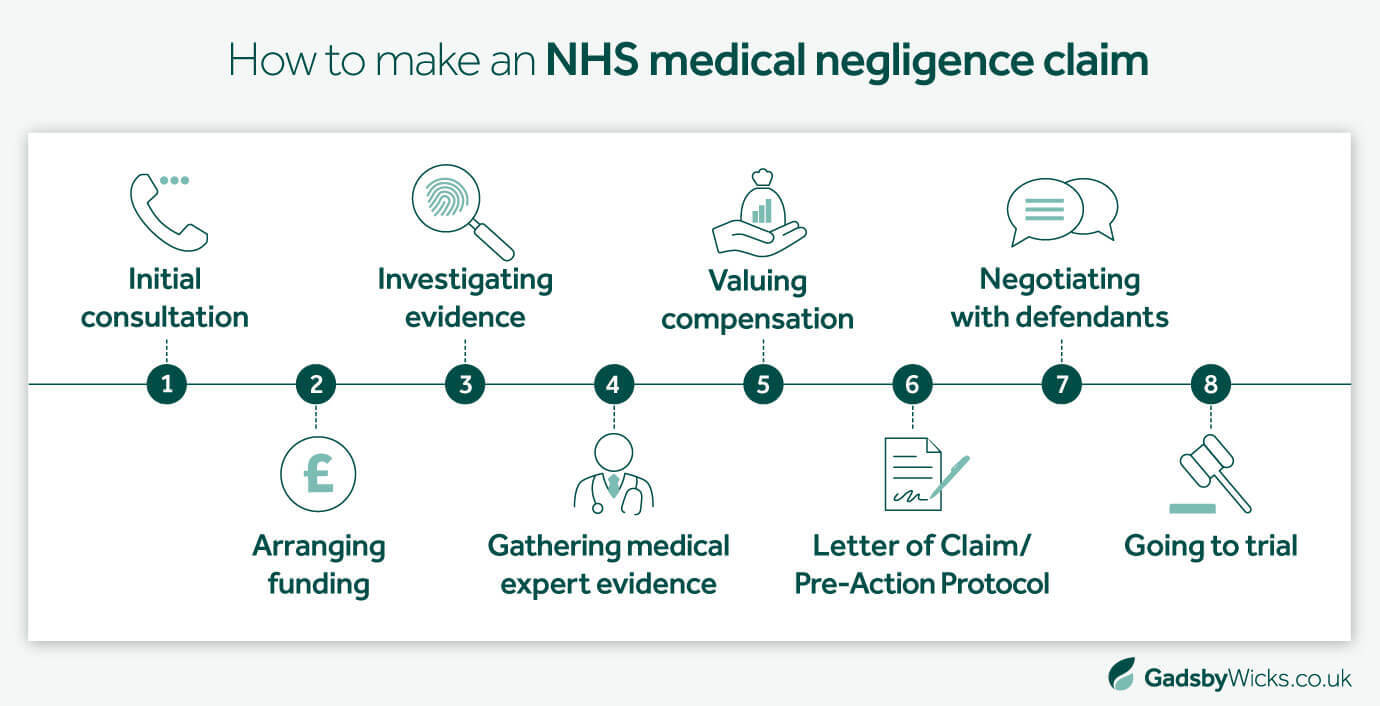
The 8 steps of making an NHS medical negligence claim
At Gadsby Wicks, we split the NHS medical negligence claims process into 8 digestible steps, making it easier for our clients to understand what they can expect.
1. Initial consultation
Your initial consultation is where you will share your experience with an experienced nurse adviser, who will ask questions about the negligence you endured.
They will then present your case to the team of medical negligence lawyers. If they believe your claim is viable, they will assign a solicitor to oversee your case and guide you through the process. At Gadsby Wicks, we only pursue claims that we truly believe we can win.
It is always preferable to have a single solicitor manage your claim – this ensures consistency and a single point of contact across this long journey.
2. Arranging funding
Next, your solicitors should discuss how you intend to fund your NHS negligence claim. In most cases, this will be one of three options:
No win, no fee agreements (or Conditional Fee Agreements): Your solicitors take on the risk of your legal costs. You pay nothing upfront and you pay nothing at all if your claim is successful.
Legal expenses insurance: You may have an existing insurance policy that will cover your legal costs.
Legal Aid: The State covers your legal costs, but this is only available in limited cases (mostly birth injury claims).
You should never face any financial risk when making an NHS clinical negligence claim.
3. Investigating evidence
Your solicitors will need to gather evidence to prove that your healthcare providers breached their duty of care and that this caused your injuries. Common types of evidence used in NHS negligence claims include:
Medical records
Witness statements
Medical notes
Photographs and videos
Financial evidence
It is normal for it to take months, even years, to gather and assess evidence.
4. Gathering medical expert evidence
While investigating your claim, your solicitors should also be contacting independent, impartial medical experts about your case.
This is often the most pivotal evidence in any claim, as these impartial experts are key to proving that your healthcare provider behaved in a manner that no reasonable professional would have done.
Moreover, these experts play a vital role in assessing the impact of your injuries and judging it against what should have happened – key to valuing compensation.
5. Valuing compensation
Based on the available evidence, the nature of your injuries and your individual circumstances, your solicitors will then quantify a fair amount of compensation to pursue.
Remember that NHS negligence compensation is not a windfall or lottery win. Its purpose is to put you back in the position you were before the negligence (insofar as that is possible) and support your ongoing care.
6. Letter of Claim and Pre-Action Protocol
With your case built, your solicitors will then present your case to the defendants.
Your solicitors should also organise a Pre-Action Protocol (PAP), which outlines the steps and conduct for both parties before court proceedings, so it may be resolved without entering trial.
7. Negotiating with defendants
Your solicitors will usually aim to negotiate a settlement before proceeding to trial. This helps you receive compensation sooner and minimises stress.
At Gadsby Wicks, 96% of claims are settled outside of the courtroom, and we advise our clients on whether offers should be accepted or refused.
8. Going to trial
If the settlement cannot be negotiated, then your case will proceed to trial.
Before this, your solicitors will introduce you to the barrister representing you, and advise you on how to handle yourself when giving evidence.
Are there time limits to make an NHS medical negligence claim?
In most cases, you have a time limit of three years to make an NHS medical negligence claim.
The time limit starts from the “date of knowledge”. This is when a reasonable patient should have become aware of their injuries, ensuring that claimants with injuries that are not immediately obvious (such as misdiagnosis) can still claim compensation.
There are exceptions to this standard limitation period:
Claimants under the age of 18 have until their 21st birthday
There is no time limit if the claimant is mentally incapacitated
If the claimant dies during their claim, the time limit restarts from their date of death
NHS negligence compensation is designed to cover a wide range of expenses, from the patient’s pain, suffering and loss of amenity (general damages), to past and future financial losses (special damages).
Examples of these costs include (but are not limited to):
Compensation for pain and suffering
Ongoing care costs and support needs
Rehabilitation, treatment and therapies
Loss of earnings
Medical equipment (mobility aids, assistive devices, etc.)
Adaptations to the home or vehicles
Travel expenses
For more information, please read our guide on medical negligence compensation. Please note that compensation is determined on a case-by-case basis, depending on the severity of the injury and its long-term impact.
Due to the incredible work the NHS does in treating millions of patients every year, some people may be reluctant or opposed to claiming against it.
This is a reasonable response, as you may be concerned if a claim will threaten the careers of those involved or harm these healthcare systems. But I can safely reassure you that claiming against the NHS does not directly hurt the organisation.
First, all NHS claims are handled by NHS Resolution, a separate body, which has a budget dedicated to it each year to compensate patients harmed by medical negligence. This means that compensation does not come directly from the affected trust, so it does not impact patient safety standards.
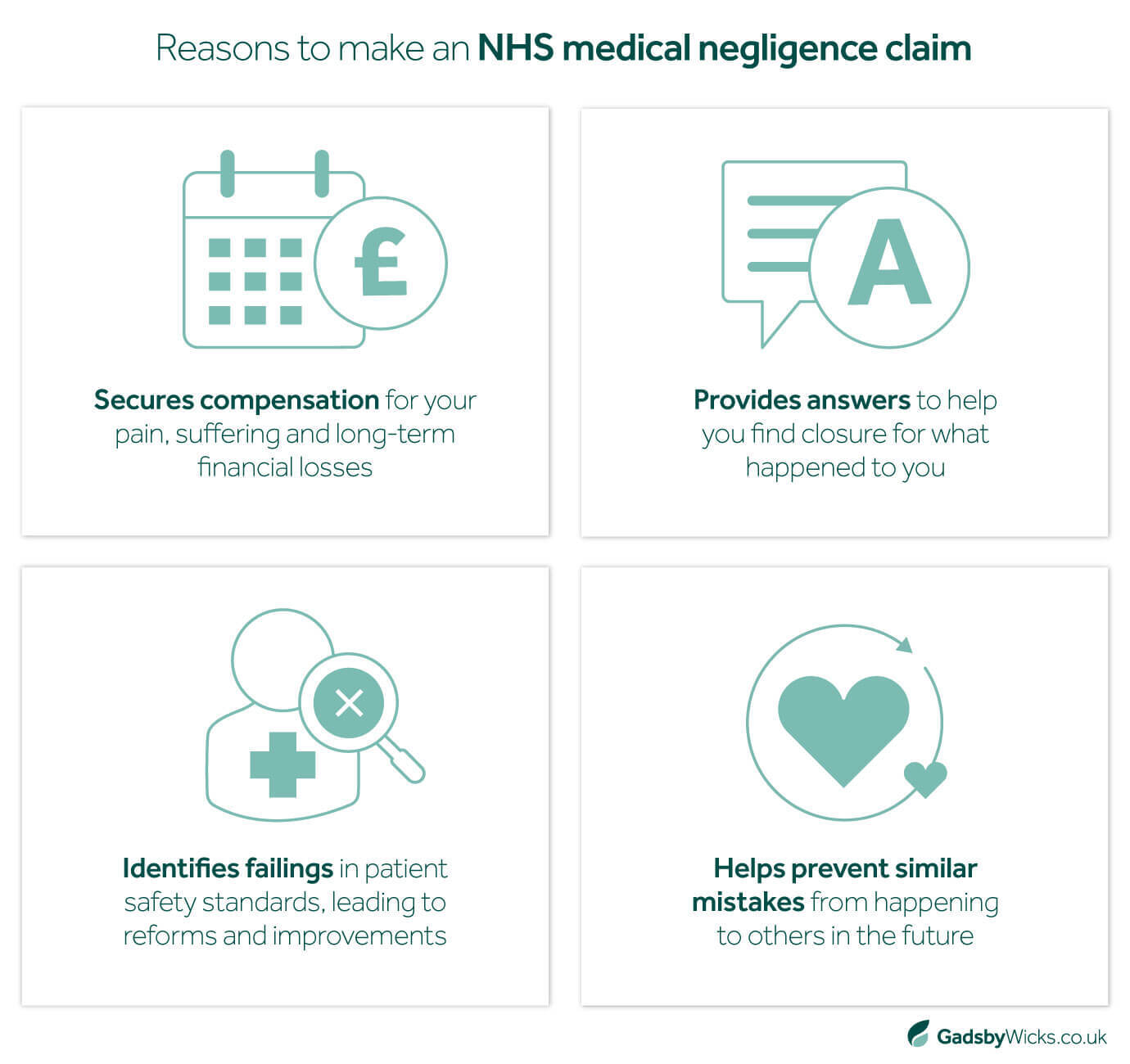
Ensure patients receive much-needed compensation and explanations following negligent treatment
Identify failings in patient safety standards, leading to reforms and improvements
Prevent the same mistakes that harmed patients from happening to others in future
Encourage healthcare professionals to learn and grow from their mistakes and the mistakes of others
Therefore, claiming against the NHS is often critical to improving healthcare services over time, and ensuring that failings are addressed and learned from.
Remember – making a claim is about answers, accountability and compensation, not about punishing those responsible.
Have an NHS negligence claim? Speak to our specialist solicitors
We hope this guide has helped you understand the process of claiming against the NHS, and answered some of the key questions you have about this.
Nevertheless, making an NHS medical negligence claim is not straightforward. It requires a great deal of time, investigation and negotiation to secure the compensation and answers that you deserve. It also requires having the right experts in your corner.
Since 1993, Gadsby Wicks has exclusively worked in clinical negligence. Our highly experienced medical negligence solicitors have managed thousands of claims against the NHS, and have recovered over £300 million for our clients.
Approaching your case with absolute transparency, openness and attention to detail, we keep you informed at every step of the journey, answering your questions and minimising stress on you and your loved ones.
Get the compensation, answers and justice you deserve – start your claim today with the true medical negligence specialists.
Disclaimer
All content contained within this article is meant for general information only – this should not be treated as a substitute for medical advice from your doctor or another healthcare provider. If you require legal advice specific to your situation, please contact our team directly.
Gadsby Wicks is not liable for any diagnosis made from the content of this article, nor does it endorse any service or external site linked to within the article.
Always consult your GP if you are concerned about your health and wellbeing, or speak to us if you require legal advice.
Tell us about your claim: what happened, when and where it took place. Your submission will be personally reviewed by one of our experienced Nurse Advisors; trained professionals who will contact you to support you through the next steps of your claim.



 Back to top