- Home >
- Accident & Emergency Negligence Claims
A&E departments treat us in our most urgent moments. In these high-pressure environments, mistakes can happen – and when they do, they can have life-changing consequences for patients and their loved ones.
If you or someone you love suffered from a misdiagnosis, avoidable delay or other A&E errors, we make sure your experience is recognised, and you get justice. With over 30 years of specialist expertise in A&E claims and millions recovered in compensation, trust us to help you find closure and secure your financial future.

Do you have an A&E negligence claim?
While A&E departments are often fast-paced, high-pressure settings, they must still deliver a suitable standard of care. If your condition is misdiagnosed, there’s a preventable delay in your treatment, or you’re discharged without proper checks, you may have a right to make an A&E negligence claim.
Our highly experienced solicitors meticulously investigate all evidence and support you at every step of your claim. Together, we work hard to get the answers you’re seeking, hold those responsible for your injuries accountable, and secure the compensation you need to move forward.

The specialist A&E negligence solicitors for Essex & East Anglia
Since 1993, our solicitors have been the medical negligence specialists in Essex and East Anglia, representing thousands of clients and recovering millions in compensation.
As ‘no win, no fee’ solicitors, we leave no stone unturned to build a watertight case that achieves the settlement you deserve, and you pay nothing unless your A&E claim is successful. Plus, with 96% of claims settled out of court, you can rely on us to help you secure the right result with minimal stress.
A&E Negligence Compensation & Payouts Guide
Compensation for A&E negligence claims can vary significantly from case to case. It depends on the severity and nature of your injuries, and the long-term complications caused by the negligent treatment.
With decades of experience handling A&E negligence claims, we have represented all manner and complexity of cases, recovering everywhere from tens of thousands of pounds for delayed treatment of fractures, to in excess of £200,000 for life-changing diagnostic errors.
Our deep understanding and strong track record help ensure we recover the compensation you deserve for your injuries and your ongoing financial security.
Understanding A&E negligence compensation in the UK
A&E negligence claims are one of the most common sources of medical negligence claims in the NHS and private sectors.
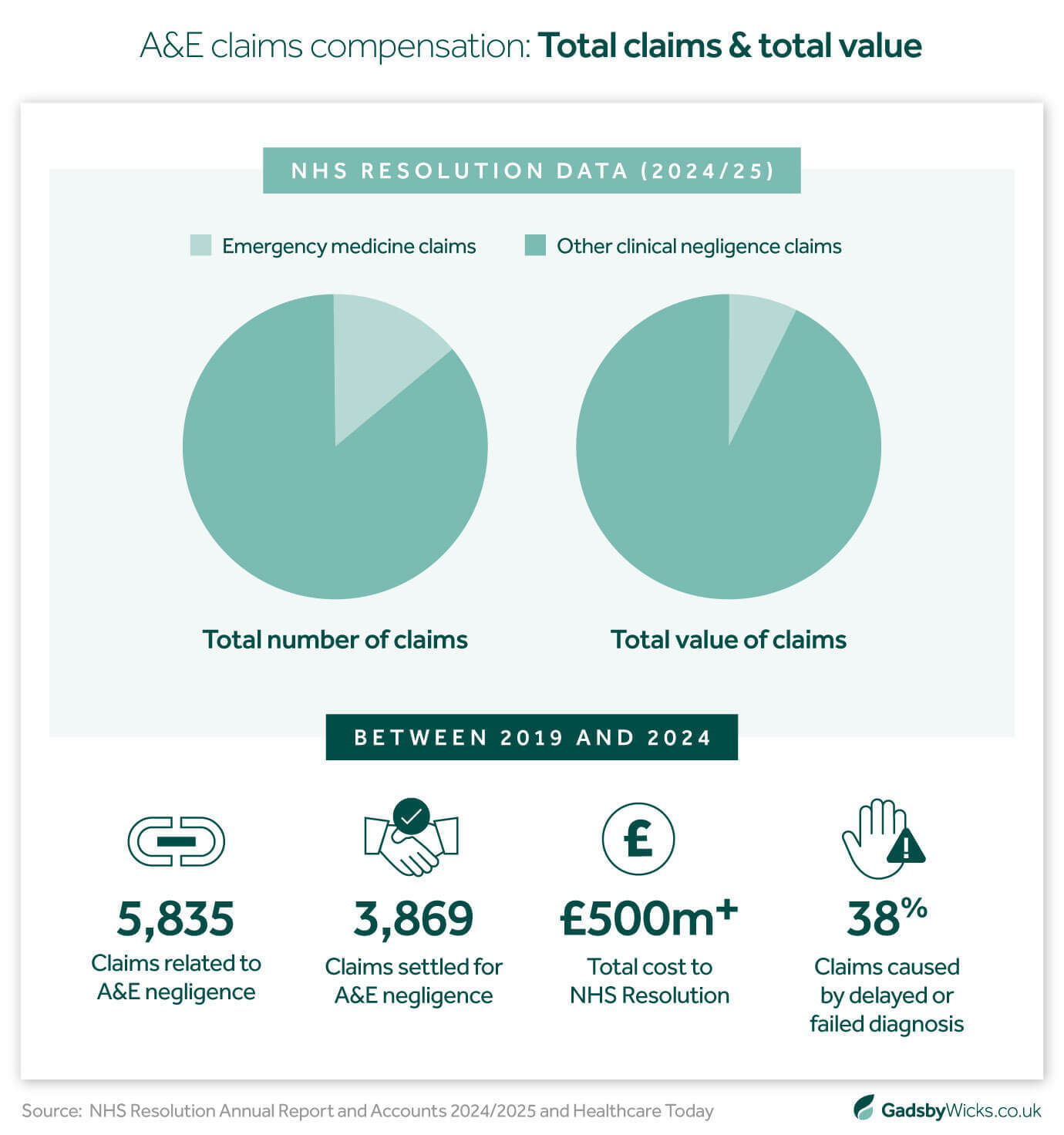
A report published by Healthcare Today revealed that between 2019 and 2024, 5,835 claims relating to A&E negligence were made against NHS Trusts, with 3,869 of them settled.
These claims cost the NHS over £500 million, with the overwhelming majority of that figure accounting for compensation to the affected patients. Furthermore, A&E delayed or failed diagnosis was responsible for approximately 38% of all claims.
This is corroborated by NHS Resolution’s annual report for 2024/25. Emergency medicine accounted for 13.9% of all medical negligence claims in this period (1600 claims), and 7.1% of the total claims value (over £476 million).
Regional A&E negligence claims data for Essex and East Anglia isn’t readily available, but in our decades of experience as medical negligence lawyers in this region, we can confidently confirm that a strong proportion of our claims relate to incidents in emergency departments.
Overall, the data suggests that emergency medicine and A&E departments are one of the most common sources of clinical negligence claims. This is unsurprising when you consider how many patients use these services each year and the high-pressure nature of these environments.
However, it is important to say that the scope for A&E negligence claims is incredibly wide, ranging from delayed treatment of fractures, to misdiagnosis of cancer, sepsis and other life-threatening conditions.
For example, a former Gadsby Wicks client attended A&E with pain in his wrist after landing awkwardly in a football match. Inadequate examination meant the fracture was missed and not treated for two years, requiring more significant surgery to repair. This claim achieved £40,000 as the long-term implications were relatively minor.
Compare this to another client, where several misdiagnoses by her GP and A&E staff allowed her bowel cancer to progress to the point that when it was finally diagnosed, it was too late to treat. Her family received £200,000 due to the fundamental impact this had on their lives and the patient’s avoidable pain and suffering.
At Gadsby Wicks, our solicitors have substantial experience pursuing A&E negligence claims. We take the time to fully understand how failings in emergency care have affected your life, working relentlessly to obtain compensation that supports your health, independence and long-term future.
How is A&E negligence claims compensation calculated?
Compensation for A&E negligence claims is split into two primary sides: general damages and special damages.
General damages for A&E negligence claims
General damages compensate claimants for the physical and psychological harm they endured due to A&E negligence. This is also called “pain, suffering and loss of amenity”.
In A&E claims, this could range from increased damage to fractures, to brain injuries and paralysis, depending on the nature of their original injury.
We may refer to the Judicial College Guidelines when calculating general damages for A&E negligence claims. This provides top-line guidance of the compensation payout for common injuries, including:
- Brain injuries
- Injuries involving paralysis
- Neck and spinal injuries
- Injuries to internal organs
- Injuries affecting the senses
- Chronic pain
- Psychiatric and psychological injuries
- Injuries resulting in death
We have referenced some JCG figures in the table below. However, be aware that these are only rough estimates – all A&E negligence claims are calculated on a case-by-case basis.
Remember that by attending A&E, patients will already be experiencing some injury or illness before any negligence occurs. So we must account for these pre-existing or ongoing health concerns when quantifying a suitable amount of compensation.
For this reason, it is vital to work with experienced A&E negligence specialists. We assess each case on its individual circumstances, ensuring any compensation properly reflects the physical and emotional harm caused by substandard emergency care.
| Severity | Estimated Value Range | Notes |
|---|---|---|
| Brain injury | ||
| Very severe | £344,150 - £493,000 | Little meaningful response to environment, little language function, double incontinence and full-time nursing care. |
| Moderately severe | £267,340 - £344,150 | Seriously disability, with a substantial dependence on others and a need for constant professional care. |
| Moderate | £52,550 - £267,340 | Moderate to severe intellectual deficit and effects on sight, speech, senses, concentration and memory. |
| Less severe | £18,700 - £52,550 | Similar problems to moderate cases, but will have made a good recovery and will be able to take part in normal social life. |
| Injury involving paralysis | ||
| Tetraplegia / Quadriplegia | £396,140 - £493,000 | Full-body paralysis where the injured person is in no physical pain, but has full awareness of their disability. |
| Paraplegia | £267,340 - £346,890 | Lower-half paralysis, with damages dependent on the extent of pain, degree of independence, life expectancy and more. |
| Amputation of arms | ||
| Loss of both arms | £293,850 - £366,100 | Double-arm amputation that reduces a person with full awareness to a state of considerable helplessness. |
| Loss of one arm | £117,360 - £167,380 | Amputation of a single arm, with values depending on extent of amputation and if it's the person's dominant arm. |
| Bowel injury | ||
| Severe | Up to £224,790 | Cases involving double incontinence – total loss of bowel function and urinary function and control. |
| Moderately severe | Up to £183,190 | Total loss of natural function and dependence on colostomy (depending on age). |
| Moderate | In the region of £97,530 | Persistent faecal urgency and passive incontinence causing embarrassment or distress. |
| Less severe | £54,420 - £85,100 | Severe abdominal injury often necessitating temporary colostomy and/or restriction on diet and employment. |
| Bladder injury | ||
| Severe | Up to £224,790 | Cases involving double incontinence – total loss of bowel function and urinary function and control. |
| Moderately severe | Up to £171,680 | Complete loss of function and control. |
| Moderate | £78,080 - £97,540 | Serious impairment of control with some pain and incontinence. |
| Less severe | £28,570 - £38,210 | Where there has been almost a complete recovery but some fairly long-term interference with natural function. |
| Digestive system injury | ||
| Severe | £46,900 - £64,070 | Severe toxicosis causing serious acute pain, vomiting, diarrhoea and fever, requiring hospital admission. |
| Serious | £11,640 - £23,430 | Serious but short-lived food poisoning, diarrhoea and vomiting diminishing over two to four weeks. |
| Moderate | £4,820 - £11,640 | Food poisoning or allergic reaction causing discomfort, stomach cramps, alteration of bowel function and fatigue. |
| Female reproductive system injury | ||
| Very severe | £140,210 - £207,260 | Infertility with sexual dysfunction, severe depression and anxiety, pain and scarring. |
| Severe | £52,490 - £124,620 | Likely permanent sexual dysfunction in the case of a person with children or who is unable to have children. |
| Moderately severe | £68,440 - £87,070 | Infertility with no aggravating features and no sexual dysfunction in a young person without children. |
| Moderate | £21,920 - £44,840 | Infertility without medical complications and no sexual dysfunction where the injured person already has children. |
| Kidney injury | ||
| Severe | £206,730 - £256,780 | Serious and permanent damage to or loss of both kidneys. |
| Serious | Up to £78,080 | Where there is significant risk of future urinary tract infection or other total loss of natural kidney function. |
| Moderate | £37,550 - £54,760 | Loss of one kidney with no damage to the other |
| Injuries affecting sight | ||
| Most severe | In the region of £493,000 | Total blindness and deafness. |
| Very severe | In the region of £327,940 | Total blindness. |
| Severe | £78,040 - £219,400 | Loss of sight in one eye with reduced vision in the remaining eye, depending on extent of vision loss. |
| Moderately severe | £66,920 - £80,210 | Total loss of one eye, depending on age, psychiatric consequences and cosmetic effect. |
| Moderate | £60,130 - £66,920 | Complete loss of sight in one eye, taking account of some risk of sympathetic ophthalmia. |
| Deafness or tinnitus | ||
| Very severe | £133,810 - £171,680 | Total deafness and loss of speech, often due to deafness occurring at an early age. |
| Severe | £110,750 - £133,810 | Total deafness, with award depending on occurrence of speech deficit or tinnitus. |
| Moderately severe | £38,210 - £55,570 | Total loss of hearing in one ear, with award depending on level of tinnitus, dizziness or headaches. |
| Moderate | £8,560 - £55,570 | Partial hearing loss and/or tinnitus. |
| Impairment of taste/smell | ||
| Severe | In the region of £47,810 | Total loss of taste and smell. |
| Moderately severe | £40,150 - £47,810 | Total loss of smell and significant loss of taste. |
| Moderate | £30,500 - £40,150 | Loss of smell only. |
| Serious | £23, 430 - £30,500 | Loss of taste only. |
| Chronic pain disorders | ||
| Severe | £51,410 - £76,870 | Significant, ongoing symptoms despite treatment, adversely impacting ability to work and requiring care/assistance. |
| Moderate | £25,710 - £46,970 | Symptoms are ongoing, albeit to a lesser degree than the above and a less marked difference on daily life. |
| Psychiatric injury | ||
| Severe | £66,920 - £141,240 | Problems affecting life, education and work, negative impact on relationships, high vulnerability and poor prognosis. |
| Moderately severe | £23,270 - £66,920 | Similar problems with a more optimistic prognosis, such as psychiatric injury following a negligent stillbirth or traumatic birth. |
| Moderate | £7,150 - £23,270 | Similar problems to the above but there will have been marked improvement by trial and a good prognosis. |
Special damages for A&E negligence claims
Special damages cover the past and future financial consequences of A&E negligence. These can include:
- Medical treatment and rehabilitation: ongoing treatment, specialist therapies and recovery programmes
- Care and support needs: professional care, assistance from family members and input from case managers
- Loss of earnings and future income: time away from work, reduced earning capacity or inability to return to your role
- Equipment, accommodation and transport: mobility aids, home adaptations and modified or specialist vehicles
- Additional expenses: travel costs for appointments, treatment and rehabilitation
Special damages often cause the greatest variation in A&E negligence compensation, as they depend heavily on the severity of injury and the individual’s long-term needs.
As experienced A&E negligence solicitors, we work closely with forensic accountants, care experts and independent specialists to accurately assess how negligent emergency care has affected your finances, ensuring your settlement is aligned with your exact requirements.
What is the average A&E negligence claim settlement in Essex?
Although this is a common question, there is no such thing as an average A&E negligence settlement. Every claim is different, and the level of compensation reflects the individual circumstances and impact of the injury.
With over 30 years of dedicated claims experience, we have achieved outcomes ranging from five-figure awards in cases causing less significant harm, to hundred-thousand-pound settlements where failures in emergency care have resulted in permanent injuries.
We do not rely on general figures or assumptions. We assess each A&E negligence claim individually, with careful attention given to how the injury has affected your life, ensuring any compensation awarded provides genuine support both now and in the future.
Should I use an A&E negligence calculator?
Online compensation calculators for A&E negligence claims do exist, but they are often unreliable and can give a false impression of what a claim may be worth. They are often designed to generate enquiries rather than provide accurate advice.
With decades of experience handling medical negligence claims across Essex, East Anglia and throughout the UK, we understand that it is not possible to value an A&E negligence claim without first meeting you and carefully examining the medical evidence.
We approach every claim with honesty and accuracy at its core. We take the time to fully understand you, the circumstances of your treatment and the effect it has had on your life before providing a considered, realistic assessment of your A&E negligence claim’s value.
What can A&E negligence compensation pay for?
If your A&E negligence claim is successful, the compensation you recover can help pay for a wide range of treatments, aids and equipment, including (but not limited to):
- Pain and suffering
- Loss of earnings (past and future)
- Medical treatment, rehabilitation and medication
- Medical equipment and mobility aids
- Long-term care and assistance
- Travel and related expenses
- Adaptations to home or lifestyle
Case studies for some of our A&E negligence claims
What does our A&E negligence claims process look like?

A free initial consultation
Call us, request a callback or complete our online form and we’ll assess if you have a valid medical negligence claim.

Funding your claim
Discover the ways we can fund your claim without you paying a penny at any stage of the process.

Investigating evidence
We gather medical records, witness statements and more to learn what happened to you and prove your claim.

Instructing independent medical experts
We work with impartial, experienced medical experts to establish whether your injuries were due to substandard medical care.

Valuing your claim
We assess your health and financial losses to accurately estimate how much compensation your claim is worth.

Presenting your case
We contact the Defendants and the Courts on your behalf to set out your allegations and receive a response.

Negotiating a settlement
We work to achieve a fair settlement for you outside the courtroom – this is how 96% of our cases end.

Preparing for Trial
If we must proceed to Trial, we fully prepare you for what to expect so you receive the right result in court.
FAQs about A&E negligence claims
What is Accident & Emergency (A&E)?
Accident & Emergency or A&E units, sometimes referred to as ED (emergency department) or casualty, is the department dedicated to urgent treatment for patients with acute or sudden illnesses, medical emergencies or severe accidental or traumatic injuries.
A&E units are often incredibly busy, fast-paced and high-pressure environments. For that reason, some delay in treatment is understandable and justifiable, as A&E professionals will prioritise the most serious and life-endangering injuries and illnesses.
However, Accident & Emergency departments must still meet an expected standard of care, known as their duty of care. If a patient receives treatment below this standard, or suffers due to an unjustifiable misdiagnosis or delay, then the patient may have the right to make a medical negligence claim.
What is an A&E medical negligence claim?
An A&E medical negligence claim is a legal compensation claim that a patient can make if they believe they were harmed due to preventable mistakes made while they were in A&E. This form of emergency care negligence often arises from avoidable clinical errors made in high-pressure environments, and applies to both NHS A&E departments and private emergency departments.
Many actions or inactions can constitute A&E negligence. For example, treatment of a fracture may be considered negligent if:
- The bones aren’t aligned properly
- The patient underwent surgery when it wasn’t required
- Surgery results in excessive scarring
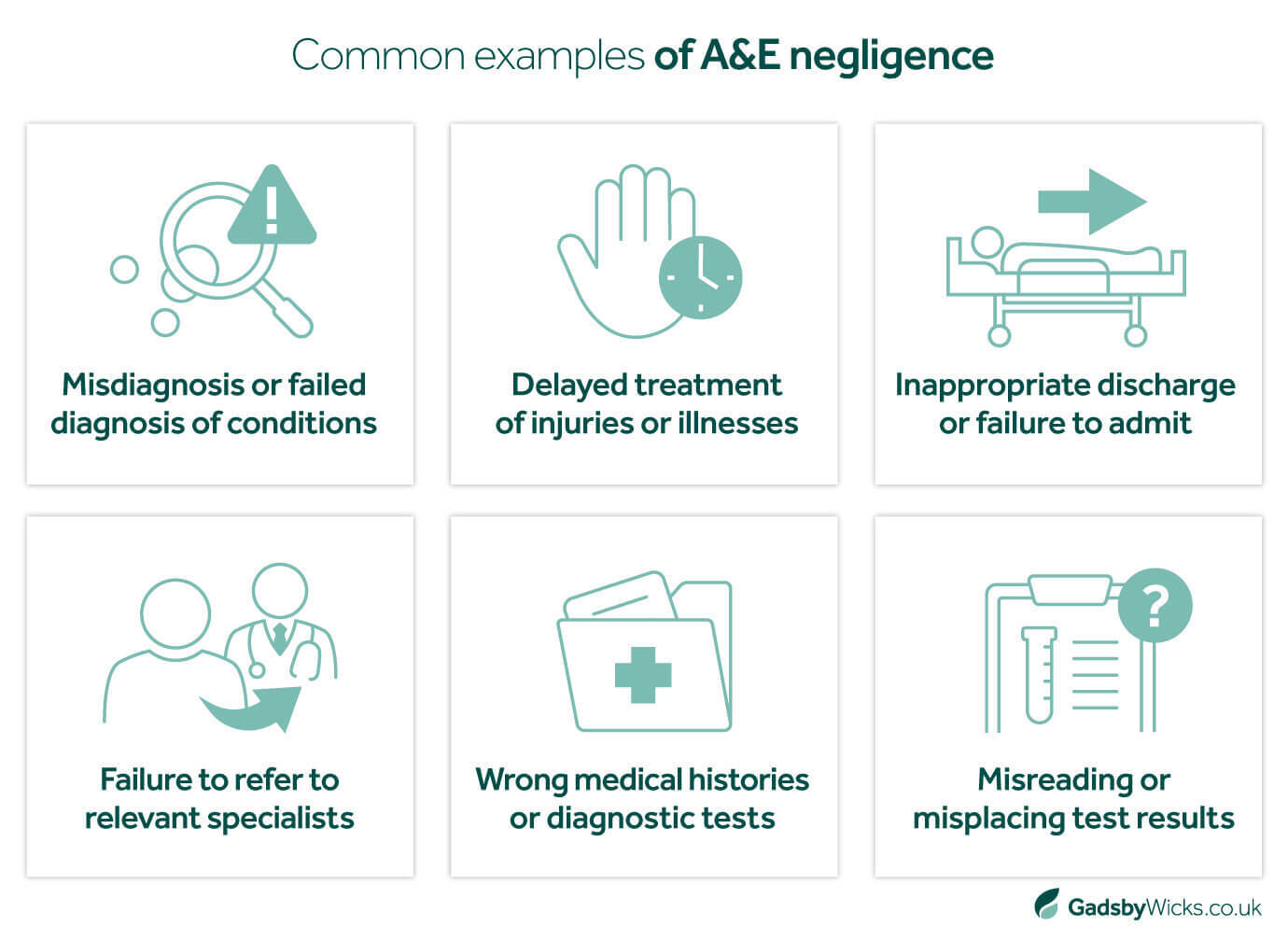
Other prominent examples of A&E negligence include a failure to diagnose conditions, delaying the treatment of injuries, failing to refer patients to the right specialist, and discharging patients while they are still in a risky condition.
However, not all injuries sustained in A&E are a result of negligence. Unavoidable medical outcomes can result in harm even when healthcare professionals provide a reasonable standard of care, such as:
- Known but highly unlikely risks materialise
- The condition is very difficult to accurately diagnose
- The patient is treated for a more life-threatening condition first (differential diagnosis)
- There are rare or unexpected reactions to medications or treatments
For there to be A&E negligence, the healthcare professionals responsible for your care must have failed to meet their expected standard of care, and that failure directly causes harm or makes your condition worse.
If you believe your injuries were caused by your hospital’s negligence, reach out to our highly experienced A&E claims solicitors about your situation.
What are common examples of A&E negligence?
While there is no specific data about the most common types of A&E negligence claims, from our 30+ years of legal experience, the most common cases we have handled include:
Misdiagnosis or failure to diagnose conditions
If A&E professionals make avoidable diagnostic errors, or take an unnecessarily long time to diagnose your condition, you may have grounds to make a medical misdiagnosis claim. Notable examples in A&E include cases of sepsis misdiagnosis, meningitis misdiagnosis, stroke misdiagnosis and heart attack misdiagnosis.
Delayed treatment of injuries or conditions
You may have a valid delayed treatment claim if it takes an avoidably long time to treat your injury or illness, or there was a failure to triage your injury or illness to the correct level of urgency.
For more information, read the following:
- Orthopaedic surgery claims
- Spinal injury claims
- Knee surgery claims
- Hip surgery claims
- Joint surgery claims
Inadequate medical histories or diagnostic tests
Failure to examine patients correctly or a failure to perform scans and diagnostic tests (blood tests, scans, etc.) can be considered negligent treatment.
Inappropriate discharge or failure to admit patients
If you were incorrectly discharged and suffered further harm as a result, or you were denied access to A&E despite having a serious injury or condition, you may have a rightful claim.
Wrong medication or prescriptions
Providing the wrong medication for a patient’s illness or supplying medication to which the patient is allergic can lead to a negligence claim.
Delayed referral to specialists
Sometimes, a patient should be referred to a specialist doctor based on their condition. If there is a failure to refer in a timely fashion and the patient suffers, that is an act of negligence.
Misreading or misplacing test results
Misinterpretation of test results, such as fractures missed on X-rays, or not following up on test results due to a clerical error, can have serious consequences for the patient.
Poor communication or record-keeping
Not managing patients correctly or failing to keep accurate records can lead to serious, avoidable harm.
If you believe that you or someone you love was affected by any of the above during their stay in A&E, contact us today and speak to our trusted medical negligence solicitors.
What injuries or conditions can result from A&E negligence?
There is a wide range of serious, long-term complications that can occur as a result of A&E negligence, including (but not limited to):
- Brain injuries
- Paralysis
- Orthopaedic injuries (spinal, fractures, etc.)
- Chronic pain
- Worsening of existing conditions
- Sepsis and serious illnesses
- Psychological harm (trauma, anxiety, etc.)
How can A&E negligence affect you or a loved one?
When mistakes are made in A&E, the consequences for you or your loved one can be immediate, devastating and potentially life-altering.
A misdiagnosis or preventable delay in treatment can allow conditions to worsen, meaning avoidable pain, the need for more invasive treatment, and a change in someone’s long-term prognosis or life expectancy. Failure to treat fractures or other injuries promptly may also lead to permanent disabilities or chronic pain.
Beyond the physical distress, these experiences can impact patients psychologically as well. This may include anxiety and PTSD, and cause patients to lose faith in healthcare services.
Negligent treatment may also make it harder for patients to work, move around and manage day-to-day tasks, especially in cases of disability. This may mean patients require long-term care and rehabilitation.
A&E negligence compensation can help cover the costs of necessary care, treatments and equipment to help mitigate the impact these consequences have on your life.
How do I prove medical negligence in an A&E claim?
To prove medical negligence in an A&E claim, you need to answer three key questions:
- Did the A&E staff breach their duty of care to you?
- Did you suffer injury, pain, loss or damage?
- Was your suffering directly caused by the breach of duty?
You must prove both breach of duty and causation to have a valid A&E negligence claim. Without either aspect, your claim will not be successful.
All medical negligence claims are judged on the balance of probabilities. This means you must prove that negligence was “more likely than not” to be the cause of your injuries, unlike criminal cases, which you must prove beyond any reasonable doubt.
As A&E claims solicitors for over 30 years, we have a wealth of experience in investigating and proving these claims, regardless of their complexity. We will thoroughly examine all available evidence, including:
- Medical records, including A&E notes and triage records
- Witness statements
- Photographs
- Hospital notes
- Financial records
- Independent medical expert reports
By assessing all evidence and working closely with our extensive network of impartial medical and non-medical experts, we will build a watertight case that secures the compensation you are owed.
Contact our expert A&E negligence solicitors
If you or someone you love suffered due to a misdiagnosis, delay or general mistreatment in A&E, speak to someone about your options. Our team is here to listen and advise you on your next steps.

Lexcel accredited medical negligence claims solicitors
We are proud to be a Lexcel-accredited practice. The accreditation is a mark of quality and comes directly from the Law Society.
A recent assessment described us as a “Centre of Excellence” and we continue to operate to the highest standards across all main areas of our field. These include client care, case management, financial management, structure and strategy, people management, risk management, information management and file management.




Industry Recognised