- Home >
- Cauda Equina Syndrome Claims
Cauda equina syndrome (CES) can have a seismic impact on someone’s life – from chronic pain and numbness, to permanent paralysis. If CES is misdiagnosed or not promptly treated, the consequences can be massive.
If you or someone you love suffered in this way, our solicitors will fight for your right to justice. For over 30 years, we have helped our clients secure hundreds of thousands of pounds in cauda equina claims, working on a no-win, no-fee basis to ensure you recover the maximum amount of compensation possible for your future.


Do you have a cauda equina syndrome claim?
If a healthcare professional misdiagnosed your cauda equina syndrome, or failed to treat it before you suffered serious harm, you may be entitled to make a cauda equina syndrome claim for compensation.
Proving that CES was caused or worsened by medical negligence is hard. By working with our highly experienced solicitors – with over 30 years’ experience in cauda equina claims – you put yourself in the strongest position to secure your financial future and move on from what happened.

The specialist cauda equina claims solicitors for Essex & East Anglia
Since 1993, our no-win, no-fee spinal injury lawyers in Essex and East Anglia have represented hundreds of clients and secured settlements worth hundreds of thousands of pounds.
We thoroughly investigate your cauda equina claim, help you challenge the negligence you endured, and recover compensation for your injuries. Working on a ‘no win, no fee’ basis, with 96% of claims settled out of court, we guide you towards the best possible result with minimal stress and zero financial risk.
Cauda Equina Syndrome Compensation & Payouts Guide
The compensation you may recover from a cauda equina syndrome claim can vary greatly based on the severity of your nerve damage and its long-term impact on your mobility, bladder and bowel function, and overall quality of life.
As experienced CES claims solicitors in Essex, we have represented claims ranging from tens of thousands of pounds for minor injuries, to millions for those faced with permanent, life-changing disabilities.
Through our deep understanding and decades of handling complex medical negligence claims, we ensure our clients secure settlements that reflect the full extent of their injuries, losses and future needs.
Understanding cauda equina claims compensation in the UK
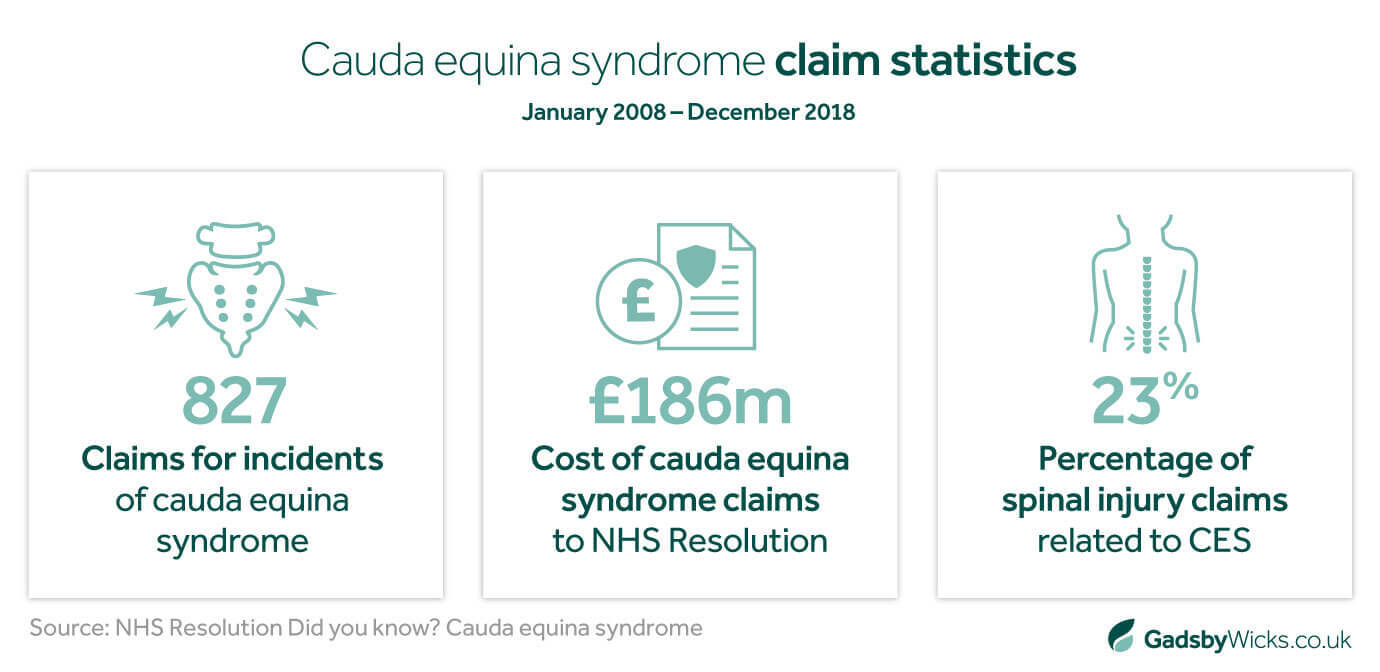
Recent data on cauda equina claims specifically is relatively sparse. However, a report on CES claims published by NHS Resolution in 2020 revealed that between January 2008 and December 2018, they received 827 claims for incidents of cauda equina syndrome.
That’s approximately 75 claims per year, and costs the NHS over £186 million in total (including compensation, claimant legal costs and NHS legal costs).
Please note: At the time of this report, only 340 of the reported 827 cauda equina syndrome claims had been settled with damages.
Furthermore, this report determined that 23% of spinal injury claims in England relate to cauda equina syndrome.
A deeper investigation into cauda equina syndrome claims in the UK revealed a total of 2,496 CES claims were made between 2012 and 2020 across NHS, non-NHS and self-employed healthcare services. Among these figures, 51 claims were attributed to negligent treatment by physiotherapists.
Overall, these figures suggest that cauda equina syndrome claims are relatively rare, but account for a high proportion of all spinal injury claims. Furthermore, average compensation values based on NHS Resolution’s data from 2008-2018 suggest that these claims often secure settlements worth hundreds of thousands, even millions of pounds.
Indeed, there are cases of claimants receiving over £1 million in cauda equina compensation for delayed diagnosis leading to significant bladder dysfunction, bowel dysfunction and sexual dysfunction.
However, it is important to note that the scope for cauda equina syndrome payouts is incredibly vast. For every multi-million pound claim, there are many more lower-value claims for less significant injuries.
At Gadsby Wicks, our solicitors are highly experienced in cauda equina syndrome claims, including highly complex, high-value cases. We take the time to understand the full impact of your injury and leave nothing unexplored, working tirelessly to secure the compensation to protect your independence, wellbeing and future.
How is cauda equina syndrome compensation calculated?
Cauda equina syndrome claims compensation is split into two main areas: general damages and special damages.
General damages for cauda equina syndrome claims
General damages are compensation for the direct physical and psychological damage caused by the negligence, also known as “pain, suffering and loss of amenity”.
In a cauda equina syndrome claim, this could refer to paralysis, bowel and bladder dysfunction and sexual dysfunction caused by preventable nerve damage.
When calculating general damages for cauda equina claims, we may refer to the Judicial College Guidelines. This offers guideline amounts of compensation which may be awarded for common injuries, such as:
- Injuries involving paralysis
- Neck and spinal injuries
- Bowel and bladder injuries
- Reproductive system injuries
- Chronic pain
- Psychiatric and psychological injuries
We have referenced some relevant JCG figures in the table below. However, these are only estimates – cauda equina compensation is calculated on a case-by-case basis.
In cauda equina syndrome claims, it is common for clients to have been experiencing back pain or other symptoms before negligent delays in diagnosis or treatment occurred. In some cases, a full recovery may never have been possible, and there may be pre-existing or ongoing health conditions that must be considered.
This is why it is essential to instruct experienced, specialist cauda equina syndrome solicitors. We evaluate every claim on its own merits, ensuring that any damages accurately reflect the physical and psychological harm caused by negligence, as well as the individual impact on our clients’ lives.
| Severity | Estimated Value Range | Notes |
|---|---|---|
| Injury involving paralysis | ||
| Tetraplegia / Quadriplegia | £396,140 - £493,000 | Full-body paralysis where the injured person is in no physical pain, but has full awareness of their disability. |
| Paraplegia | £267,340 - £346,890 | Lower-half paralysis, with damages dependent on the extent of pain, degree of independence, life expectancy and more. |
| Bowel injury | ||
| Severe | Up to £224,790 | Cases involving double incontinence – total loss of bowel function and urinary function and control. |
| Moderately severe | Up to £183,190 | Total loss of natural function and dependence on colostomy (depending on age). |
| Moderate | In the region of £97,530 | Persistent faecal urgency and passive incontinence causing embarrassment or distress. |
| Less severe | £54,420 - £85,100 | Severe abdominal injury often necessitating temporary colostomy and/or restriction on diet and employment. |
| Bladder injury | ||
| Severe | Up to £224,790 | Cases involving double incontinence – total loss of bowel function and urinary function and control. |
| Moderately severe | Up to £171,680 | Complete loss of function and control. |
| Moderate | £78,080 - £97,540 | Serious impairment of control with some pain and incontinence. |
| Less severe | £28,570 - £38,210 | Where there has been almost a complete recovery but some fairly long-term interference with natural function. |
| Female reproductive system injury | ||
| Very severe | £140,210 - £207,260 | Infertility with sexual dysfunction, severe depression and anxiety, pain and scarring. |
| Severe | £52,490 - £124,620 | Likely permanent sexual dysfunction in the case of a person with children or who is unable to have children. |
| Moderately severe | £68,440 - £87,070 | Infertility with no aggravating features and no sexual dysfunction in a young person without children. |
| Moderate | £21,920 - £44,840 | Infertility without medical complications and no sexual dysfunction where the injured person already has children. |
| Chronic pain disorders | ||
| Severe | £51,410 - £76,870 | Significant, ongoing symptoms despite treatment, adversely impacting ability to work and requiring care/assistance. |
| Moderate | £25,710 - £46,970 | Symptoms are ongoing, albeit to a lesser degree than the above and a less marked difference on daily life. |
Special damages for cauda equina claims
Special damages relate to the past and future financial impact of negligent care of cauda equina syndrome. These may include:
- Medical treatment and rehabilitation: specialist therapies, pain management, and long-term rehabilitation programmes
- Care and support needs: professional care services, assistance provided by family members, and involvement of case managers
- Loss of income and future earning capacity: time off work, reduced hours, or an inability to return to previous employment
- Equipment, housing, and transport requirements: mobility aids, home modifications, bathroom adaptations, and adapted vehicles
- Associated expenses: travel costs for medical appointments, rehabilitation sessions and consultations
Special damages are often where you see the largest disparity in compensation for cauda equina claims, as they vary significantly based on a person’s unique circumstances and long-term care needs.
As experienced CES claim solicitors, we work with leading forensic accountants, case managers, and independent experts to build a detailed picture of how your injury has affected – and will continue to affect – your finances. This ensures your settlement special is carefully tailored to your exact requirements.
What is the average cauda equina syndrome claim settlement in Essex?
While we are often asked this question, the truth is that there is no average cauda equina syndrome claim settlement. Each claim is unique, and the compensation awarded is equally unique.
Over more than 30 years of exclusive experience in medical negligence claims, we have secured compensation ranging from five-figure sums in cases of delayed diagnosis with limited lasting effects, through to million-pound settlements for individuals left with permanent paralysis and bowel or bladder dysfunction.
A true clinical negligence specialist does not rely on averages or assumptions. We approach every cauda equina syndrome claim on its own merits, taking the time to understand how the injury has affected your life so that any compensation awarded provides meaningful support both now and in the years ahead.
Should I use a cauda equina compensation calculator?
Online calculators for cauda equina syndrome claims are available, but they can be misleading. They are more often designed to capture leads rather than deliver useful guidance.
Through our decades of representing medical negligence claims in Essex, East Anglia and UK-wide, we know that we cannot estimate your claim before meeting you face-to-face and reviewing the evidence.
We put honesty and accuracy at the heart of everything we do, and we don’t make promises we can’t keep. As no two cauda equina syndrome claims are the same, we take the time to fully understand you, your injury, and its impact before we estimate what your claim is worth.
What can cauda equina syndrome compensation pay for?
After a successful cauda equina syndrome claim, the compensation you recover can pay for numerous treatments, aids and equipment, including (but not limited to):
- Compensation for your overall pain and suffering (general damages)
- Loss of earnings (both past and future)
- Rehabilitation, physiotherapy and other ongoing treatments
- Necessary adaptations to homes and vehicles
- Specialist medical equipment and aids, such as mobility aids and bladder or bowel management tools
- Ongoing personal care, provided by professional carers or loved ones
- Psychological support
What does our cauda equina syndrome claims process look like?

A free initial consultation
Call us, request a callback or complete our online form and we’ll assess if you have a valid medical negligence claim.

Funding your claim
Discover the ways we can fund your claim without you paying a penny at any stage of the process.

Investigating evidence
We gather medical records, witness statements and more to learn what happened to you and prove your claim.

Instructing independent medical experts
We work with impartial, experienced medical experts to establish whether your injuries were due to substandard medical care.

Valuing your claim
We assess your health and financial losses to accurately estimate how much compensation your claim is worth.

Presenting your case
We contact the Defendants and the Courts on your behalf to set out your allegations and receive a response.

Negotiating a settlement
We work to achieve a fair settlement for you outside the courtroom – this is how 96% of our cases end.

Preparing for Trial
If we must proceed to Trial, we fully prepare you for what to expect so you receive the right result in court.
FAQs about cauda equina syndrome claims
What is cauda equina syndrome (CES)?
Cauda equina syndrome, or CES, is a serious spinal condition where nerves in the lower back become severely compressed. The cauda equina nerves are responsible for our legs and feet, and control our bladder, bowel, anal and genital areas.
Cauda equina syndrome is a very rare condition, with estimates suggesting it affects only 1-3 people per 100,000 in the UK.
Nonetheless, compression of the cauda equina nerves is a medical emergency, requiring immediate treatment to relieve this pressure. If not diagnosed or treated promptly, CES can have severe consequences, including permanent paralysis of the lower half of the body.
If this describes what happened to you or someone you love, get in touch. Our specialist paralysis claims solicitors will help you get the compensation and justice you are owed.
What causes cauda equina syndrome?
The most likely causes of cauda equina syndrome include:
- A sudden, large herniated disc: A slipped disc or disc prolapse can put immense pressure on the cauda equina nerves at the base of the spine.
- Physical trauma to your lower back area: A spinal injury can also compress your cauda equina nerves.
- A spinal tumour: If a tumour in your spine grows, it can put pressure on the nerves in your lower back.
- An infection or inflammation: This can cause the lower back area to swell, putting additional pressure on the nerves.
- A blood clot: Blood clots may create a spinal epidural hematoma, or by obstructing blood flow to the cauda equina nerve roots, leading to compression and damage
- Surgical errors: Mistakes during spinal surgery can damage or compress nerves in your lower back
- Pre-existing spinal conditions: Long-term conditions such as spina bifida or spinal stenosis can increase the likelihood of cauda equina syndrome
What are the symptoms of cauda equina syndrome?
Common symptoms or red flags of cauda equina syndrome include:
- Lower back pain
- Radiating spinal pain
- Weakness or numbness in the legs and feet
- Numbness in the buttocks and perineal area (saddle anaesthesia)
- Sexual dysfunction
- Bladder problems, such as difficulty passing urine
- Faecal incontinence
- Laxity of the anal sphincter
- Foot drop (inability to lift the foot due to severe spinal cord compression)
Although cauda equina syndrome is rare, GPs, doctors and other healthcare professionals must be alert to these red flags, to ensure patients receive MRI scans, neurosurgical reviews and spinal surgery as soon as possible.
Without prompt diagnosis and treatment, CES can have drastic consequences. If this has affected you or a loved one, our specialist solicitors will help prove your cauda equina claim.
How do doctors treat cauda equina syndrome?
Cauda equina syndrome is considered a medical emergency, requiring swift treatment to prevent permanent nerve damage.
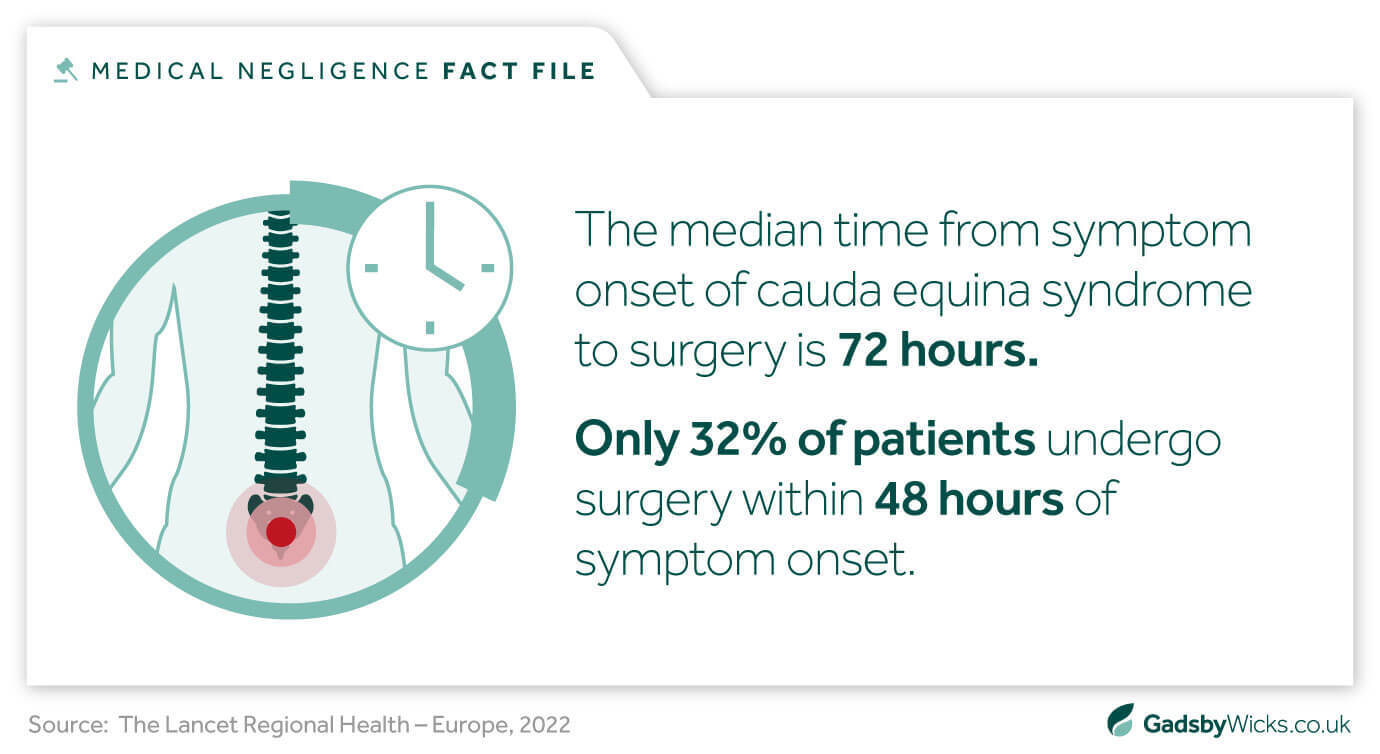
Surgery should be performed within 1-2 days of symptoms presenting to relieve compression of the nerves. Outside of this window, the risk of irreversible damage greatly increases.
Even with prompt and successful surgery, some people may not regain full function. Recovery outcomes depend largely on how severe the nerve damage was at the time of surgery and how quickly the condition was treated. Any delay, reasonable or otherwise, can be extremely costly.
After surgery, patients often need extensive rehabilitation, including physical therapy, occupational therapy, and pain-management strategies. These programmes are tailored to address specific deficits and help individuals regain as much function as possible.
Cauda equina negligence claims help those affected secure the long-term treatment and rehabilitation they require.
When can I make a cauda equina syndrome claim?
You can start a cauda equina syndrome claim if a healthcare professional misdiagnosed your CES or delayed treatment of your CES, and this caused you physical, psychological or financial injury.
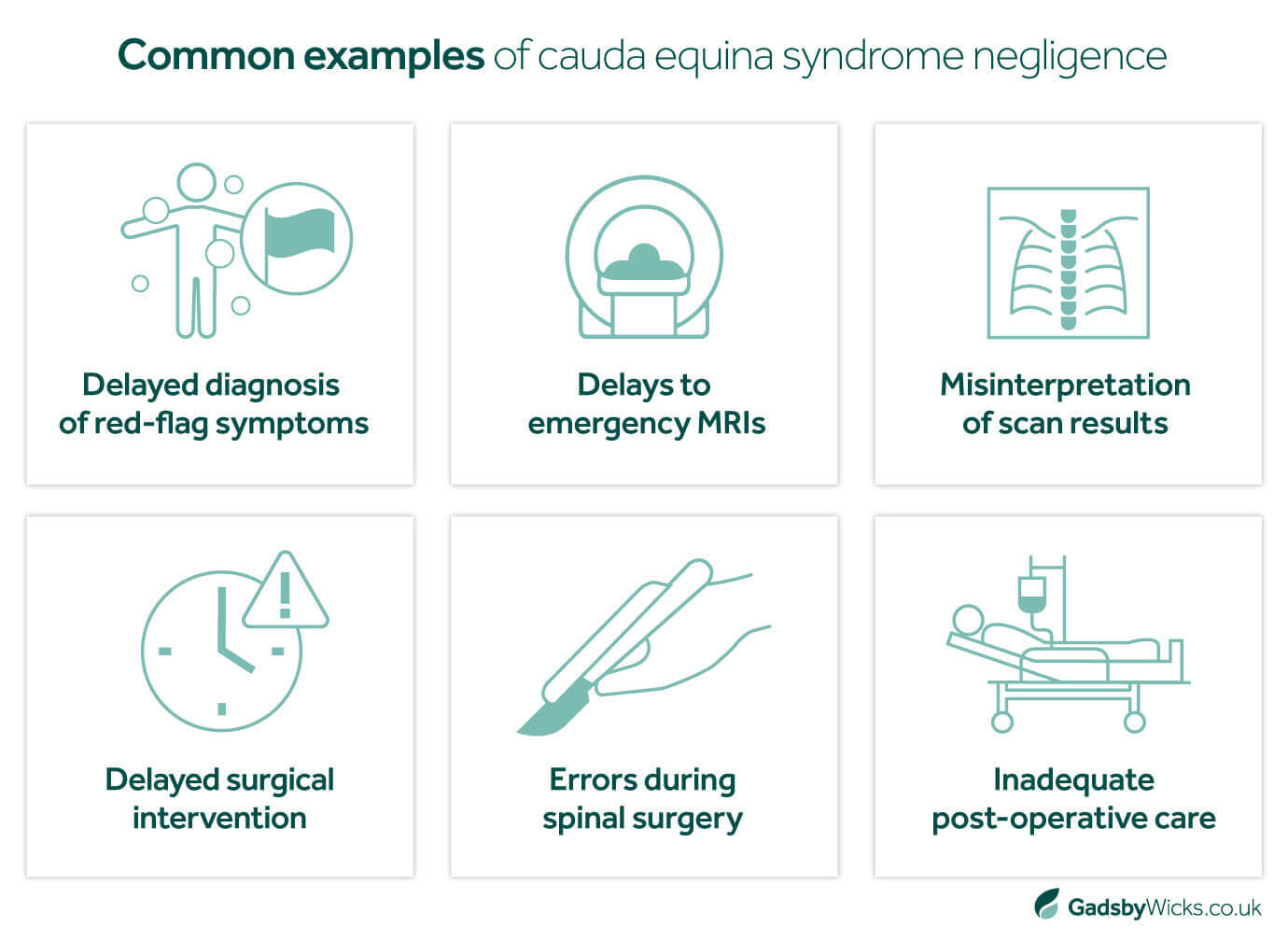
Common examples of cauda equina syndrome negligence include:
- Failing to recognise red-flag symptoms of cauda equina syndrome
- Performing an inadequate medical history or examination
- Emergency MRI delays or misinterpretation of MRI scan results
- Not referring to neurosurgery or orthopaedics when CES is suspected
- Delaying surgical intervention
- Inadequate discharging or safety-netting advice
- Providing inadequate or inappropriate treatment
If you believe you or a loved one was affected by any of the above, and this directly caused or worsened their cauda equina syndrome, please contact our highly experienced solicitors.
How do I prove I have a cauda equina syndrome claim?
To have a valid cauda equina syndrome claim, you must prove three details:
- Your healthcare provider breached their duty of care to you
- You suffered injury, pain, injury, loss or damage
- Your suffering was directly caused by the breach of duty
Cauda equina syndrome claims must be proved on the balance of probabilities. This means that you only need to prove that it is more likely than not (over 50% chance) that your healthcare provider’s negligence caused your injuries. You do not need to prove your claim beyond a reasonable doubt.
As specialist medical negligence solicitors since 1993, we will investigate all available evidence to help you prove the above statements, including:
- Medical records
- Diagnostic imaging and hospital notes
- Witness statements
- Photography
- Financial records
- Medical reports by independent healthcare professionals
No matter the complexity of your cauda equina syndrome case, we have the expert knowledge and track record to prove what went wrong in your care, so you can secure the compensation you deserve.
For more information, please refer to our claims process guide.
Contact our expert cauda equina syndrome claims solicitors
If you or a loved one’s cauda equina syndrome was caused or worsened due to the mistakes of a healthcare professional, speak to us about your options. Our team is here to listen and advise you on your next steps.

Lexcel accredited medical negligence claims solicitors
We are proud to be a Lexcel-accredited practice. The accreditation is a mark of quality and comes directly from the Law Society.
A recent assessment described us as a “Centre of Excellence” and we continue to operate to the highest standards across all main areas of our field. These include client care, case management, financial management, structure and strategy, people management, risk management, information management and file management.


Industry Recognised