

 Back to top





- No win. No fee.
- No hidden costs
- 100% risk-free, only pay if you win
- Home >
- Insights >
- Medical Negligence >
- Court of Protection & Deputies in medical negligence claims
About the Author

Tami Frankel
Medical Negligence Solicitor and Partner - LLB (Hons) University College London
Read more about Tami »Securing compensation in a medical negligence claim is just the beginning. Making sure it is managed properly is what allows it to truly change someone’s life for the better.
Sadly, those affected by substandard treatment are not always capable of managing their compensation. This may be due to a negligent brain injury, or a pre-existing condition such as dementia.
A skilled Deputy, appointed by the Court of Protection, helps ensure that a claimant’s best interests are protected. Below, we explain what a Deputy does, when they are appointed, and how they support vulnerable claimants.
This article includes quotes from Brian Bacon, a professional Court of Protection Deputy and Partner at Thomson Snell & Passmore, taken from his interview with Tami Frankel in Series 4, Episode 2 of the Medical Negligence Matters podcast.
Your guide to Court of Protection Deputies
What is a Court of Protection Deputy?
A Deputy is someone appointed by the Court of Protection to make decisions on behalf of someone who lacks the mental capacity to manage their own affairs.
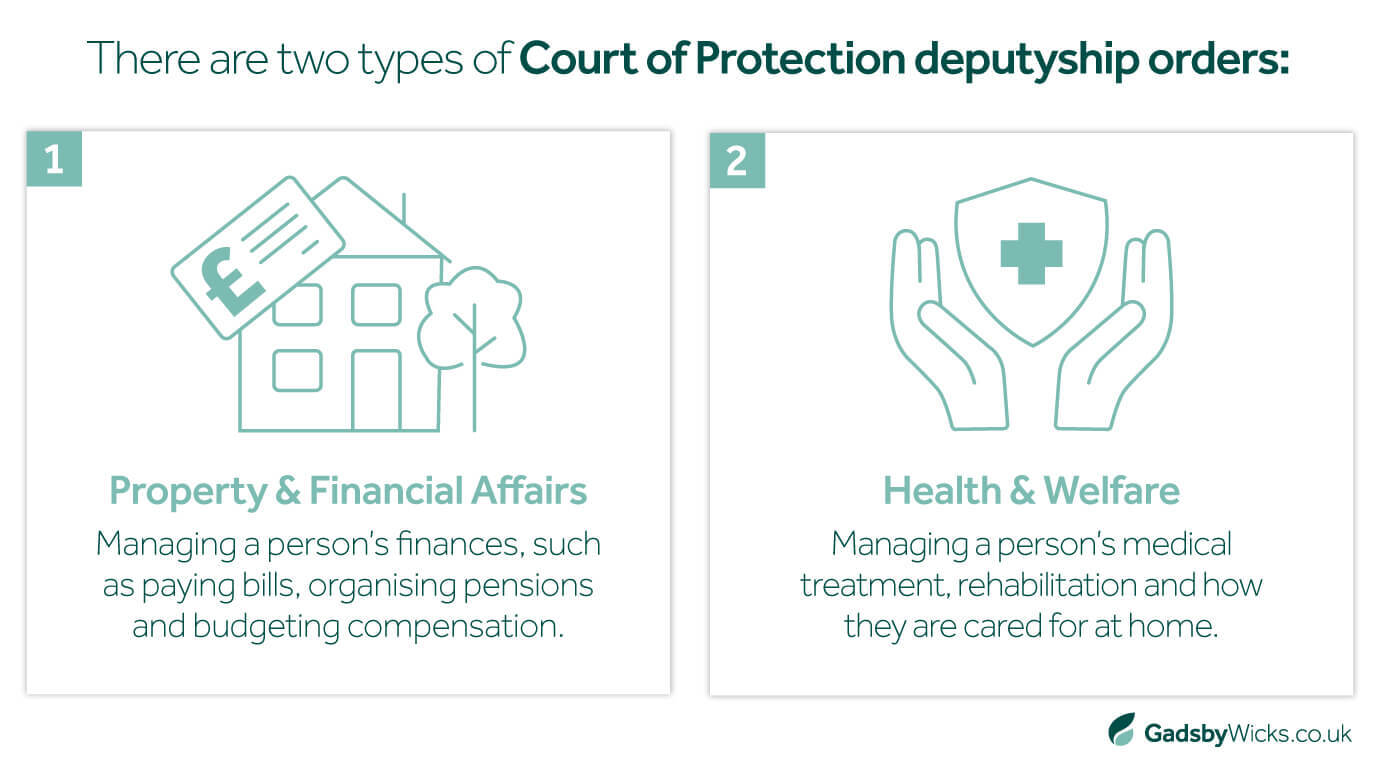
The tests for determining someone lacks mental capacity are outlined in the Mental Capacity Act 2005.
Who can be a Court of Protection Deputy?
Anyone over the age of 18 can apply for deputyship, including family members and friends. The Court of Protection will decide if the person applying for deputyship is suitable for the role based on the injured person's needs.
Multiple people can be appointed as someone’s Deputy. They may be appointed jointly (all decisions are made together) or jointly and severally (some decisions can be made separately).
For information about how you can apply for deputyship online, visit the GOV.UK information page on deputyship.
What is the Court of Protection?
The Court of Protection was formed under the Mental Capacity Act to make decisions on behalf of individuals who lack the mental capacity to do so themselves. They often delegate these responsibilities to a court-appointed Deputy.
The Court of Protection also deals with decisions that a Deputy cannot make, discharge existing Deputies and appoint new Deputies.
What is the Office of the Public Guardian?
The Office of the Public Guardian (OPG) supervises Deputies and attorneys, separately from the Court of Protection.
Deputies must submit detailed annual reports to the OPG on decisions made on their client’s behalf, including financial records. This layer of supervision helps prevent exploitation or mismanagement of the injured person’s finances or welfare.
When would a Professional Deputy be appointed in a medical negligence claim?
A Professional Deputy is a court-appointed expert, usually a solicitor or accountant, who makes financial, legal or welfare decisions on behalf of a vulnerable client.
They are typically appointed if a claimant lacks mental capacity and does not have a Lasting Power of Attorney (LPA) – a legal document that allows someone to appoint trusted people to make decisions on their behalf if they lose mental capacity.
Furthermore, the client must have an estate or funds to justify the cost of a Professional Deputy. If someone only receives benefits or has minimal amounts of money, the Court would be cautious about appointing a Professional Deputy.
Can a family member or friend become a Deputy rather than a professional?
When large sums of compensation are awarded, the Court of Protection will often recommend that a Professional Deputy is appointed over a family member or friend.
This means that the compensation is managed by an independent, objective party, who can work with the family to ensure that it is administered in the injured person’s best interests.
Furthermore, the practical and emotional aspects of managing another person’s finances can be more challenging than families may expect:
“I’ve been involved in cases that settled some time ago, and then the family realises that managing those funds is very difficult,” says Brian.
“It’s not just the practical aspects, but also the relational aspects between family members, which often puts them into conflict.”
How much does it cost to retain a Professional Deputy?
A Professional Deputy will charge fees to manage the finances or welfare of their client. If they are appointed during the medical negligence claims process, these fees can be included in the final settlement.
That is why it is so important to make that decision before a claim is resolved. If you do not appoint a Professional Deputy until after the compensation is awarded, you would need to pay their fees separately.
What does a Professional Deputy do?
Fundamentally, a Professional Deputy’s main responsibility is to act in their client’s best interest within the scope of their deputyship order.
More specifically, their responsibilities include:
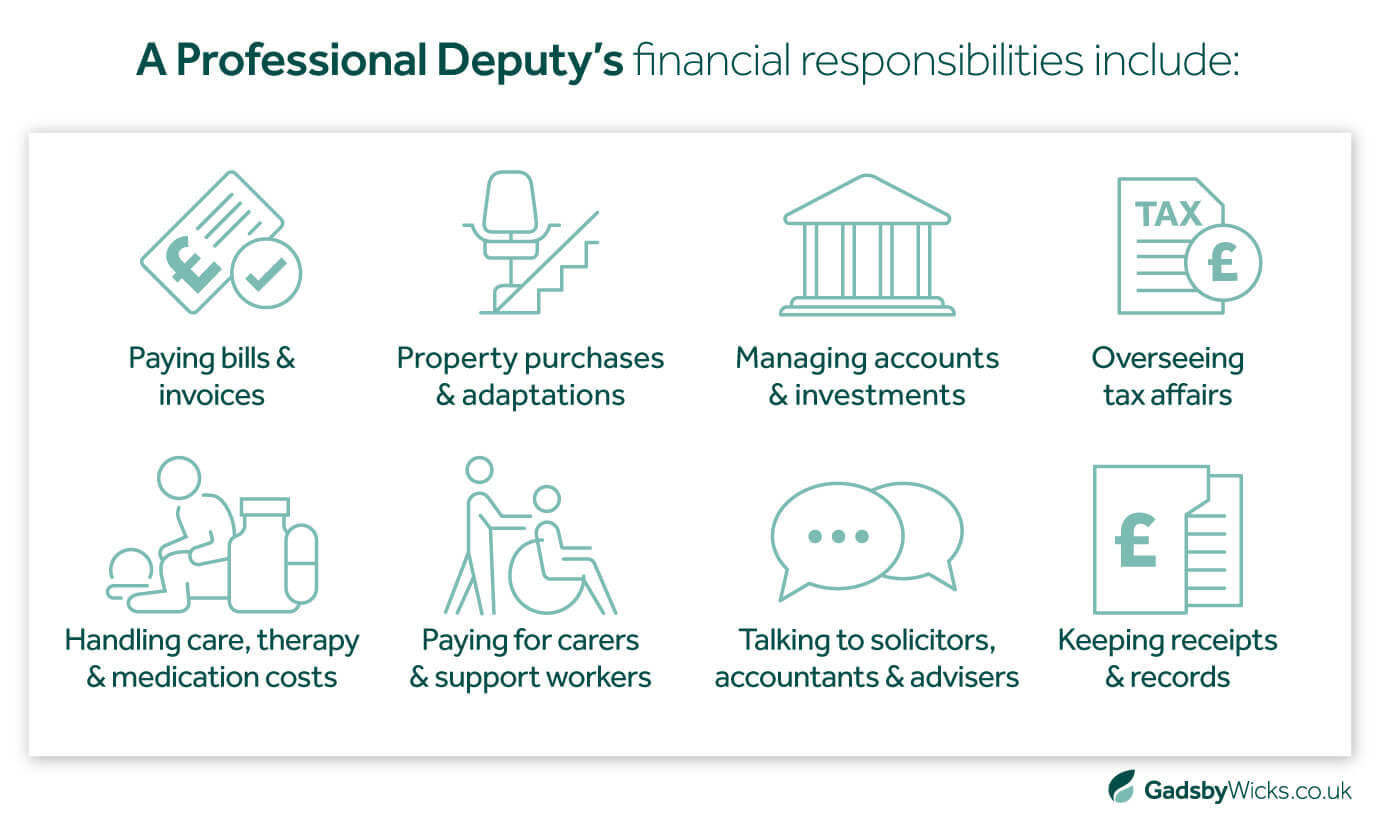
A Professional Deputy also works closely with solicitors, case managers and other experts to understand their client’s practical and medical needs. This helps ensure the compensation is budgeted for every requirement, and that decisions are made in the claimant’s best interests.
“The relationship between a Deputy, the case manager and the family is a really vital one,” explains Brian.
“They're on the ground, and understand a lot more of some of the practical and clinical needs. The case manager will often come to us and talk about decisions as well as the family, so it’s a really important relationship.”
The Deputy will also produce annual reports for the Office of the Public Guardian, detailing all income, expenditure and significant decision-making.
Balancing responsibility and compassion
In our experience, we know families often worry a Deputy will take ownership of their loved one’s finances without considering their opinions or concerns.
This is why we work with people like Brian who recognise the family’s insight, without letting their compassion steer them away from objective decisions.
“Compassion is part and parcel of our role, and it's got to be central to the decision-making,” says Brian.
“That doesn’t mean we say yes to everything. It's about taking a holistic approach and understanding not just the client's needs, but the wider needs of the family.”
Another key element is ensuring that the compensation – which can be hundreds of thousands or even millions of pounds – is budgeted to support the claimant for the rest of their life.
“A former senior judge of the Court of Protection once said that if you can spend the last penny of a client's money on the last day of their life, then you've done your job,” explains Brian.
“It's no good to eke out your client’s compensation so that they pass away with huge sums still in their bank account. It's about finding that balance between enabling someone to enjoy their life to the fullest and making sure that there are sufficient funds for their future.”
The threat of financial exploitation
Another area of concern for families when appointing a Deputy is whether they have their loved one’s best interests at heart. Although it is rare, financial exploitation is a real danger:
“A lady that I worked with for many years who was elderly and suffered from dementia befriended someone much younger than her,” says Brian.
“She was a very wealthy lady, so they started taking advantage of her, cutting her off from friends and family and accessing her bank accounts. We got involved when authorities had been alerted to this. We came in to protect her accounts and ensure the person who’d abused her finances was held accountable.”
Appointing a trusted, experienced Professional Deputy significantly minimises the risk of exploitation. At Gadsby Wicks, we help direct our clients to trustworthy Deputies who adhere to the OPG’s Professional Deputy Standards, so that they feel confident that their loved one’s best interests are central to every decision.
When should families start to consider Deputyship?
If your loved one was injured due to negligent treatment, and they lack the mental capacity to manage their finances, we recommend starting the process to appoint a Deputy as soon as the defendant admits liability. Acting early:
- Ensures the Deputy’s fees are included in the final settlement
- Gives the Deputy time to know the claimant and their family, as well as their specific goals and priorities
- Allows time for the Deputy to work with solicitors, case managers and other experts
- Helps the family become familiar with the concept of a Deputy and their involvement in their loved one’s life
“If we can become involved in those early stages, it helps our relationship with the family in multiple ways,” explains Brian.
“For us, we quickly get to understand the goals and priorities for our client. For the family, they get time to understand the role of a Deputy and become used to that.”
“We're not ignorant to the fact that it's a strange thing for a family to have someone they've never met before parachuted in to help manage a relative's money. Starting early allows for a more seamless, gradual adjustment period.”
At Gadsby Wicks, we work quickly when introducing Deputies to our clients’ families. We believe the sooner this relationship is established and allowed to bed in, the sooner action can be taken to support our client’s care and quality of life.
Does a deputyship last forever?
If an injured person develops or regains mental capacity at any time, their Deputy is obliged to present evidence of this to the Court of Protection and apply to be discharged.
A Deputy can also be changed at any time following an application to the Court of Protection.

Get compensation, answers and justice for your loved one with Gadsby Wicks
The compensation from a successful claim is only useful when managed correctly, whether it is covering the costs of ongoing treatments and medication, or paying for carers’ salaries and adaptations to the home.
The right Court of Protection Deputy, alongside the right legal team, ensures that funds are protected, decisions are made with genuine care, and your family can focus on supporting your loved one rather than navigating complex financial responsibilities.
With over 30 years of experience guiding families through the claims process and a strong network of professional connections, we can help you with the appointment of a trusted Deputy to oversee your loved one’s finances now and for the future.
Start your claim today to find out how we can help secure the compensation, answers and justice your family deserves.
We’d like to thank Brian Bacon for his contributions to this article and to the Medical Negligence Matters podcast. For more insight on Court Deputies, please watch Series 4, Episode 2 of the podcast: “Court Deputies & Protecting The Vulnerable”.
Disclaimer
All content contained within this article is meant for general information only – this should not be treated as a substitute for medical advice from your doctor or another healthcare provider. If you require legal advice specific to your situation, please contact our team directly.
Gadsby Wicks is not liable for any diagnosis made from the content of this article, nor does it endorse any service or external site linked to within the article.
Always consult your GP if you are concerned about your health and wellbeing, or speak to us if you require legal advice.
Do you have a negligence claim?
Meet our medical negligence claims solicitors
Related Insights




Medical Negligence
Can you sue a hospital for medical negligence?

Caragh Hargreaves
- 5 min read