Sometimes it isn’t possible for the person injured by negligent treatment to make a claim themselves. They may be too young to pursue a legal case, lack the required mental capacity, or sadly no longer be with us.
However, this does not mean they are denied the compensation and justice that they rightly deserve. Instead, they must depend on somebody to make the claim for them, known as a Litigation Friend.
This guide explains who Litigation Friends are and what they do in a medical negligence claim, and offers advice if you ever need to make a claim on someone's behalf.
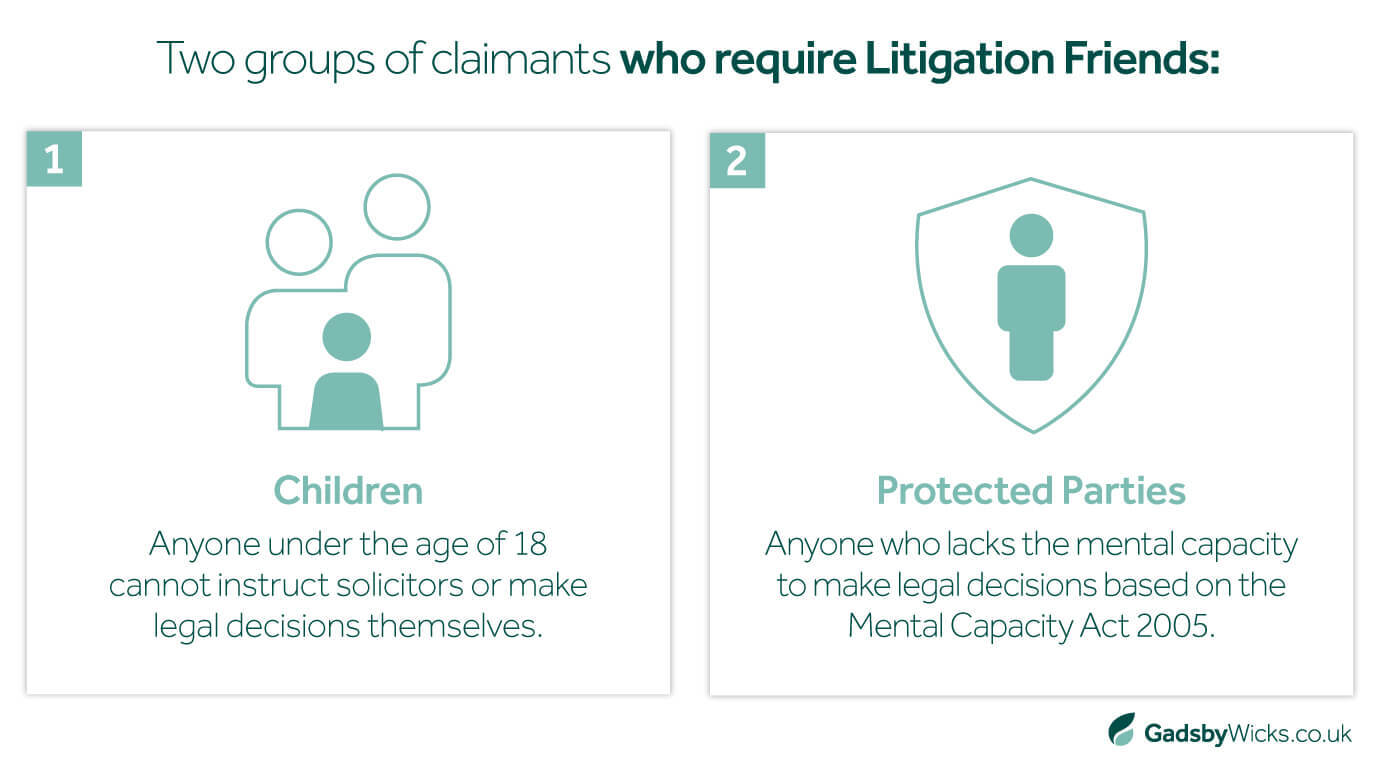
A Litigation Friend means someone who conducts legal and court proceedings on behalf of someone who cannot do so themselves. Two groups of claimants require Litigation Friends:
Children: Anyone under the age of 18 cannot instruct solicitors or make legal decisions alone. Litigation Friends are needed when claiming compensation for a child injured by negligent treatment.
Protected Parties: A protected party is an individual who cannot manage their own affairs, often because they lack mental capacity due to a brain injury or mental disability (in accordance with the tests established in the Mental Capacity Act 2005).
When making a claim on behalf of someone who has passed away, you are not acting as a Litigation Friend. In these circumstances, the person who brings the claim would normally be either the executor named in the deceased’s will, or an administrator appointed by the courts.
This person will assume all of the claims for loved ones who were financially dependent on the deceased, ensuring they receive the compensation they are due.
Anyone over the age of 18 can be a Litigation Friend as long as they can perform the role fairly and competently in the best interests of the claimant.
In many cases, a family member will act as the Litigation Friend for a loved one, such as a parent, sibling, partner or adult children. However, other suitable candidates for Litigation Friends may include:
Close friends
Legal guardians
Social workers
Professional carers
The court may also appoint a professional to act as a Litigation Friend, such as a solicitor, advocate or Court of Protection Deputy.
What are the responsibilities of a Litigation Friend?
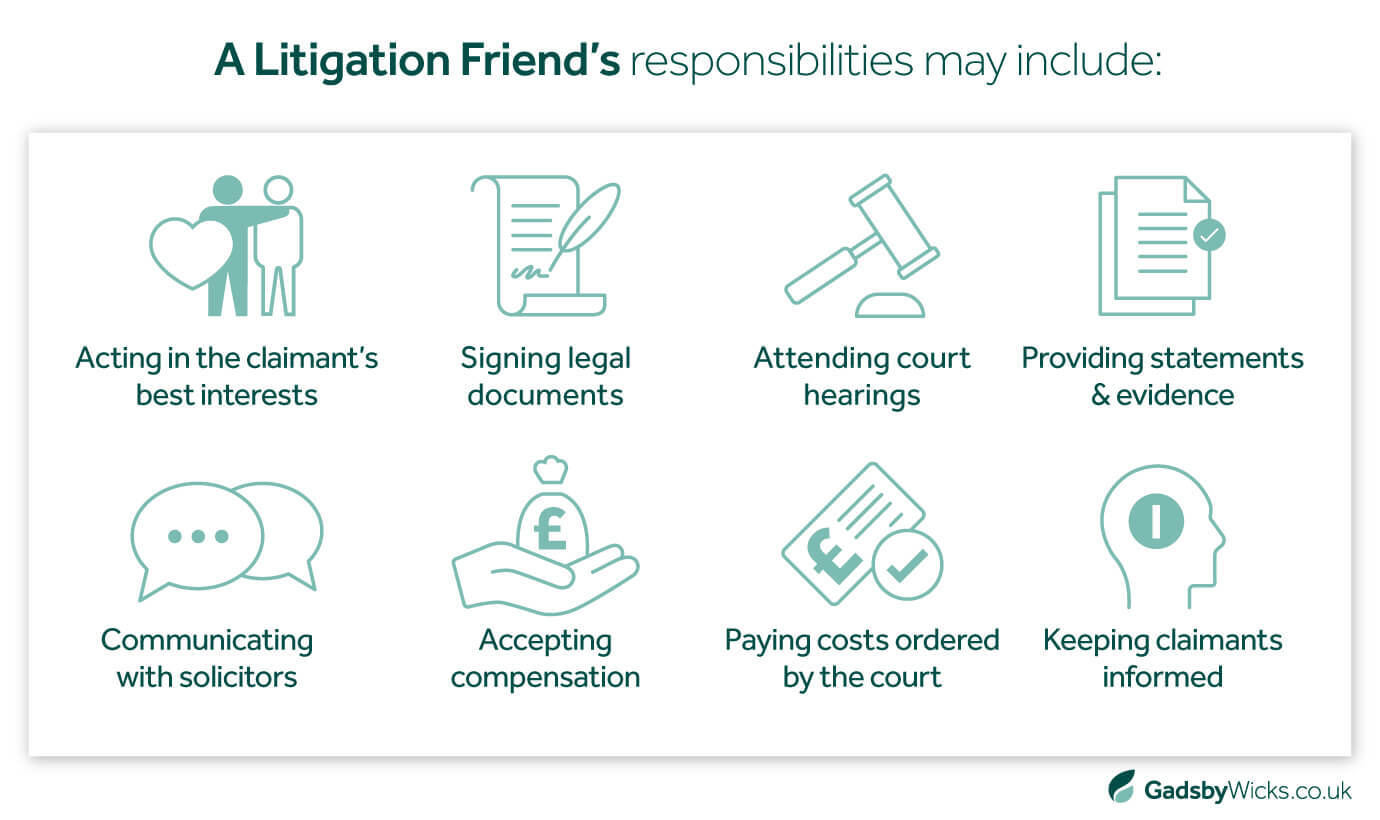
The primary responsibility of a Litigation Friend is to act in the claimant’s best interests at all times. They should always make decisions based on what they believe is best for the person they are representing – never in their own personal interests.
Beyond this, the Litigation Friend may need to carry out tasks and make decisions that a claimant would need to fulfil in a conventional civil litigation case:
A Litigation Friend should also do everything they can to explain what’s happening to the claimant and find out their wishes and feelings.
Please be aware that being a Litigation Friend is a big responsibility. Depending on the complexity of a claim and the severity of the injuries involved, it may take several years to resolve.
“It's a lot of work being a litigation friend, and it's a lot of responsibility,” explains Tami Frankel, one of our Partners at Gadsby Wicks.
“It’s a big ask, which is why it’s good for a Litigation Friend to be close to the claimant, because they’ll care enough to ensure that person gets the compensation they need to be looked after properly.”
Take time to consider whether you can handle the burden of being a Litigation Friend. Don’t feel under pressure to accept this role if you are not – alternative options do exist.
You can either apply to become a Litigation Friend, or be appointed by the court if someone involved in the case requests this.
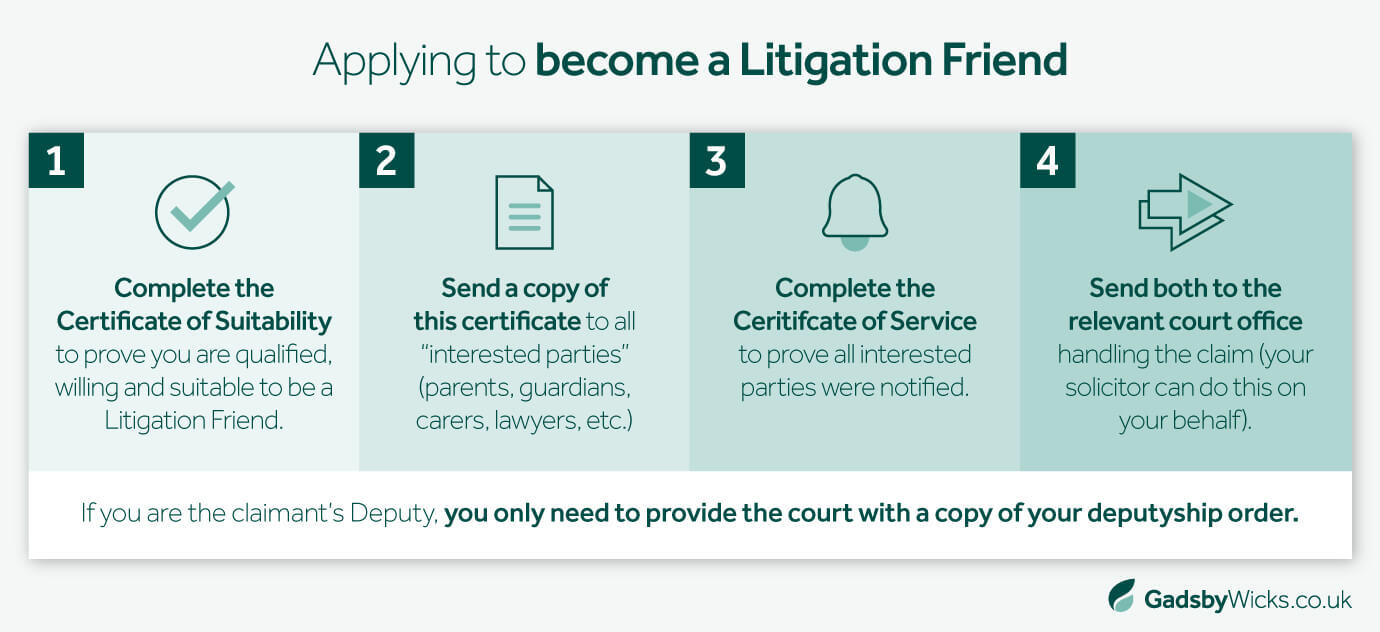
You can apply to become a Litigation Friend in one of two ways:
1. Submitting your Deputyship order
If you were appointed the claimant’s Deputy by the Court of Protection, submit a copy of that court order. This permits you to act as their Litigation Friend. You’ll remain their Litigation Friend until either:
The claim ends
The claimant turns 18 (if they’re a child)
The claimant regains mental capacity (if they’re a protected party)
2. Completing a Certificate of Suitability
A Certificate of Suitability that proves your interests do not conflict with the claimant’s, and you can make decisions fairly and competently.
Alongside this, you will also need to complete a Certificate of Service. This proves that all interested parties (parents, guardians, carers, etc.) were formally notified of your appointment as a Litigation Friend.
As experienced medical negligence claim solicitors, we can help you complete all necessary forms and submit them to the relevant people on your behalf.
What happens if no one is available to act as Litigation Friend?
As mentioned earlier, claiming on someone’s behalf can be highly stressful and emotional. If no one is either available, suitable or willing to be a claimant’s Litigation Friend, the Official Solicitor can assume the role instead.
The Official Solicitor is an independent public official who represents children and vulnerable adults lacking the mental capacity to manage their own affairs in court.
Can I step down from being a Litigation Friend?
Yes, you can voluntarily step down from being a Litigation Friend. If someone else is willing to assume the role, they can follow the process above to replace you. If no one suitable is available, the Official Solicitor can take over instead.
Fundamentally speaking, the medical negligence claims process is no different for a Litigation Friend than for a typical claimant. The Litigation Friend assumes the role of the claimant, and works closely with their solicitors at each step of the process.
The biggest difference is that the court must approve any resolution, whereas in a conventional claim it does not. An impartial, experienced judge will verify that the outcome is fair and represents the claimant’s best interests, rather than leave money on the table.
“It’s an extra layer to ensure that the settlement is fair,” explains Tami.
“Someone who does have mental capacity can accept a settlement that is unfair or too little if it suits them for other reasons. But someone lacking mental capacity cannot do that, so the court must approve the settlement to be sure it is in their best interests.”
The other major difference in a claim involving a Litigation Friend is how compensation is dealt with. In the case of child claimants, for example, their compensation will be invested in court and remain there until the child turns 18.
For claimants who lack mental capacity, compensation will need to be managed by another responsible person for the rest of the claimant’s life (or the point they regain capacity).
This is where a Court of Protection Deputy may be required. A Deputy is appointed by the Court of Protection to make decisions over their client’s Property & Financial Affairs and/or their Health & Welfare matters.
The Deputy could be a parent, another family member or close friend. However, the Court of Protection may recommend appointing a Professional Deputy instead, such as a lawyer or financial adviser.
“Usually most people realise that they would be better off having a Professional Deputy to deal with the administration and to ensure the money is properly spent and invested,” says Tami.
“Especially in larger cases involving lots of care and therapies, there will be many contacts providing those services. You may even end up employing people. In these instances, a Professional Deputy can typically manage things better than an ordinary family could.”
Do you want to make a claim on someone else’s behalf?
We hope this guide has helped you understand the role of the Litigation Friend, and the process of making a claim on someone else’s behalf.
At Gadsby Wicks, we do not underestimate the stress and emotional strain of representing a loved one’s claim. You want to ensure they receive the compensation they need to support their future, and get answers about what went wrong with their treatment, but you may feel unsure about stepping into this position.
Since 1993, our solicitors have worked with hundreds of Litigation Friends across a wide variety of claims, from the relatively straightforward to the highly complex. We help you navigate every step of the journey, explaining what’s required from you in clear language and providing compassionate support in the hardest moments.
Together, we ensure that you are fully prepared to take on this role, and that your loved one achieves a fair, positive outcome through meticulous investigation and robust negotiation.
If you know someone who may have a claim, reach us today through our short online form, or contact us to speak directly with our specialist team.
All content contained within this article is meant for general information only – this should not be treated as a substitute for medical advice from your doctor or another healthcare provider. If you require legal advice specific to your situation, please contact our team directly.
Gadsby Wicks is not liable for any diagnosis made from the content of this article, nor does it endorse any service or external site linked to within the article.
Always consult your GP if you are concerned about your health and wellbeing, or speak to us if you require legal advice.
Tell us about your claim: what happened, when and where it took place. Your submission will be personally reviewed by one of our experienced Nurse Advisors; trained professionals who will contact you to support you through the next steps of your claim.



 Back to top