Medical Negligence

Can I sue a pharmacy for medical negligence in the UK?

Updated: 11th Feb 2026
10 minute read
Can you sue a pharmacy 1248x844
  • No win. No fee.
  • No hidden costs
  • 100% risk-free, only pay if you win

About the Author

Medical Negligence Solicitor and Partner - Degree in Law (LLB)

Read more about Corrina »

Many people wrongly assume that medical negligence claims only apply to mistakes made by doctors or within hospitals. 

In reality, any healthcare professional who owes you a duty of care can be the target of a medical negligence claim, including pharmacists and chemists.

Although rare, pharmacy mistakes and errors can have just as devastating an impact as other forms of clinical negligence – from severe allergic reactions to allowing patients’ pre-existing health conditions to progress.

In this guide, we will explain common examples of pharmacy dispensing errors, who is responsible for mistakes, and what you need to know about making a pharmacy negligence claim.

How can pharmacy negligence occur?

In 2024/25, NHS and community pharmacies in England dispensed a record 1.16 billion prescription items – approximately 104,000 items per pharmacy.

Against this huge demand, the overwhelming majority of prescriptions are dispensed safely and accurately. Nonetheless, mistakes do happen, and can have severe consequences for patient safety.

The most common examples of pharmacy negligence in the UK include:

  • Mixing up prescriptions, meaning the incorrect medication is supplied to patients
  • Wrong dosages given by the pharmacy to the intended patients, or miscommunication on doses
  • Incorrect labelling of medication
  • Missed drug interactions, either with a patient’s existing medications or their general health (allergies, deficiencies, etc.)
  • Failure to check prescriptions are correct before passing them onto patients
  • Misplaced medical records, leading to delays or errors
  • Incorrect medicine storage and maintenance, affecting potency
  • Giving patients incorrect information on using a particular medication, or improper over-the-counter medication advice
  • Failure to advise patients on the side effects of their prescribed medication

Any of the above pharmacy errors could be considered negligent if they caused physical or psychological harm to a patient. The adverse effects of dispensing the wrong medication can range from mild, short-term illnesses, to life-threatening reactions such as anaphylaxis, exacerbation of asthma or kidney problems.

If you believe that you, or someone you love, was caused harm by the pharmacy errors outlined above, or another mistake made by your pharmacist or chemist, read on to find out how you can pursue a compensation claim.

How common is pharmacy negligence in the UK?

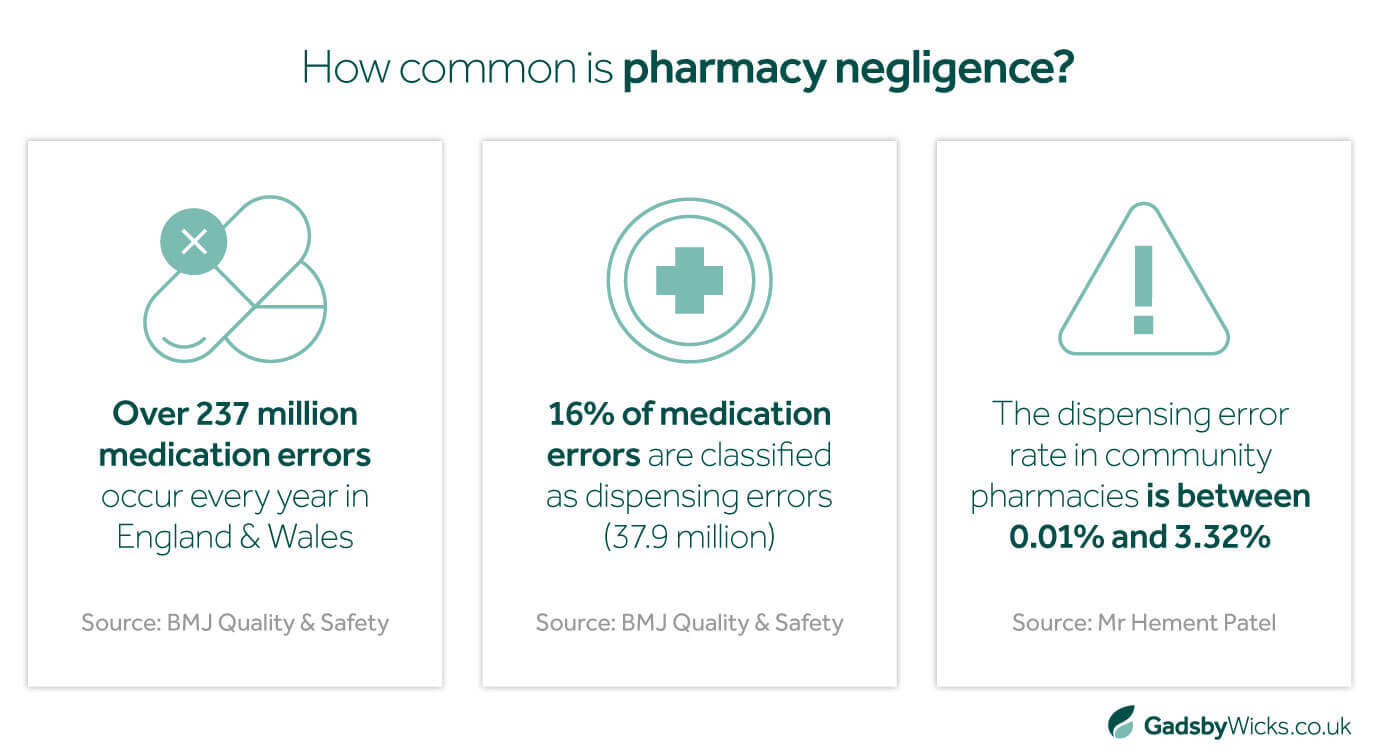
Research published in BMJ Quality & Safety several years ago revealed that over 237 million medication errors were made every year in England and Wales.

16% of these errors (approximately 38 million) were categorised as “dispensing errors”, or errors that occurred in hospital or community pharmacies.

Further research has shown an error rate of up to 3.32% in community pharmacies, and up to 2.7% in hospital pharmacies.

These numbers are thankfully small when we consider the billions of items dispensed every year across the country. But in the rare cases of serious harm, it is vital that pharmacies are held accountable, both for the financial security of the patient affected, and to help prevent future mistakes.

Gadsby Wicks infographic showing how common pharmacy negligence is, which may result in a medication claim: Sourced from BMJ Quality & Safety and Mr Hement Patel

Who can be held responsible for pharmacy mistakes?

Liability for pharmacy errors can reside with several professionals, both inside and outside the pharmacy itself:

  • Pharmacists/chemists: The Responsible Pharmacist on duty is accountable for the safe and effective running of the pharmacy and the activities of staff under their supervision
  • Pharmacist staff/technicians: Others involved in the dispensing process, such as pharmacy technicians, may also be held accountable for specific actions or errors
  • The pharmacy owner: The company or owner of the pharmacy can be liable, especially if the error resulted from systemic issues within the business
  • Prescribing doctors/GPs: If the mistake came from the original prescription, the responsible doctor or GP may be held liable for this
  • Hospitals/NHS trusts: In a larger hospital or NHS trust building, the facility itself may be liable for the negligence of its staff

If the NHS or another hospital directly runs the pharmacy, it will be the NHS Trust or the hospital’s responsibility to pay any compensation to the claimant. If a privately owned pharmacy is responsible for the patient’s harm, their insurers will likely cover any compensation awarded.

Who outlines the regulatory standards of care in pharmacies?

The legal responsibilities of pharmacists in the UK are outlined in the 9780111161524">Pharmacy (Preparation and Dispensing Errors – Registered Pharmacies) Order 2018.

In addition, the General Pharmaceutical Council (GPC) standards present the nine guidelines that pharmacy professionals must adhere to in their work:

  1. Provide person-centred care
  2. Work in partnership with others
  3. Communicate effectively
  4. Maintain, develop and use professional knowledge and skills
  5. Use professional judgement
  6. Behave in a professional manner 
  7. Respect and maintain the person’s confidentiality and privacy
  8. Speak up when they have concerns or when things go wrong
  9. Demonstrate leadership

When the standard of care given to a patient falls below an acceptable standard, and the patient suffers harm as a result, that is when a negligence claim can be pursued.

What are the potential risks of a pharmacy error?

The ramifications of a pharmacy error are incredibly varied, and depend on the significance of the error, the patient’s health, the risks associated with certain medications and several other factors.

Fortunately, the majority of medication errors have little to no impact. 72% of medication errors cause no more than minor harm to the patient, while just 2% result in serious harm.

At the milder end of the spectrum, patients could experience temporary side effects, reduced effectiveness due to the wrong dosage or strength, or symptoms worsening in the short term.

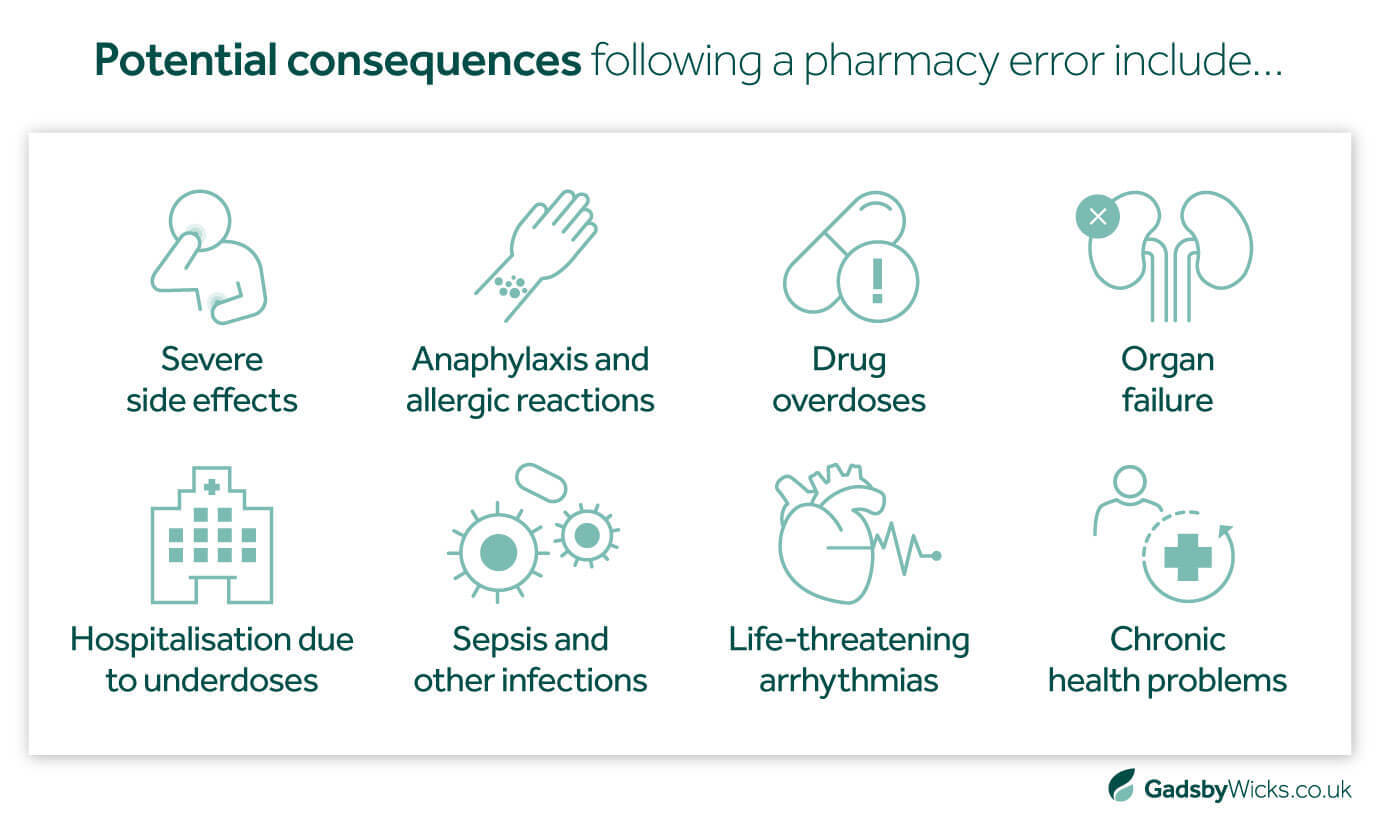
However, in rare cases, these mistakes can have severe outcomes, including (but not limited to):

  • Hospitalisation due to overdose, underdose, or adverse drug interactions
  • Organ injuries, such as kidney or liver damage
  • Bleeding events from anticoagulant errors
  • Anaphylaxis and other allergic reactions
  • Toxicity
  • Life-threatening arrhythmias
  • Sepsis due to improperly treated infections

In the worst-case scenarios, a medication or prescription error can result in a patient’s death.

That is why, even though they are very rare, mistakes must be identified, reviewed and challenged to reduce the number of severe incidents and improve patient safety in pharmacies nationwide.

Read more about the causes and risks of prescription and medication errors.

Gadsby Wicks asset sharing 8 potential consequences of pharmacy negligence, including severe side effects, allergic reactions, drug overdoses and infections

How do I make a pharmacy negligence claim?

Practically speaking, making a pharmacy negligence claim is no different to making any other form of medical negligence claim. However, before speaking with a solicitor or adviser about your situation, it is worthwhile to do the following:

Seek medical advice about your treatment

Speak to a healthcare professional about your prescription and the impact it has had on your wellbeing. Also, they can help ensure you receive the correct medication for your underlying condition.

Clarify the medication you were supplied

Keep a record of what medication you were prescribed and supplied – the more exact you can be, the better for proving your case.

Retain medication, packaging, labels and instructions

Gather all physical evidence you can related to the medication you received, as this will be invaluable for your claim.

Record your symptoms and their impact

Try to write down how your medication affected your health, with a timeline if possible. You do not need to remember everything, but it will help you recall events when speaking to a solicitor.

Starting a pharmacy negligence claim

With these preliminary steps taken, you should then reach out to a reputable medical negligence law firm to start your claim:

  1. You are interviewed by a nurse adviser and/or screening adviser, who will ask questions about your situation and review any preliminary evidence you have
  2. Your case will be reviewed by the partners and senior solicitors of the firm to determine your claim’s chances for a successful outcome
  3. If your claim is valid, you are assigned a dedicated solicitor to manage your case from start to finish and investigate all available evidence

From here, your solicitor should guide you through your claim with complete transparency, answering any questions you have along the way. For more information about making a pharmacy negligence claim, read our claims process guide.

Please note that you do not need to make a complaint against the pharmacy or your pharmacist before pursuing a claim. If you wish to do this, follow the specific complaint procedures of the pharmacy, or report your concerns to the GPC.

Is there a time limit to make a pharmacy negligence claim? (H3)

Yes. Like other claims, you typically have a three-year time limit to make a pharmacy negligence claim. The three years start from the date you became aware of your injuries, also known as the Date of Knowledge.

There are exceptions to this rule:

  • Patients under the age of 18 have until their 21st birthday
  • There is no time limit if the claimant is mentally incapacitated
  • If the patient dies during their claim, the three-year time limit restarts

Please be advised that every claim is at the discretion of the court. So, even if your injury occurred over three years ago, we recommend reaching out to a solicitor – they can advise on whether your case may still be accepted.

What evidence is required to prove pharmacy negligence?

A successful pharmacy negligence claim must prove (on the balance of probabilities):

  1. Your pharmacy or pharmacist owed you a duty of care
  2. Your pharmacy or pharmacist breached that duty of care
  3. The breach of duty directly caused you harm (causation)

Proving these elements depends on the quality of evidence presented. Evidence needed for a pharmacy negligence claim can include:

  • Prescription and pharmacy records
  • Medication packaging and labels
  • Receipts for your medication
  • Medical records
  • Witness statements
  • Correspondence with your pharmacy
  • Photography
  • Financial records
  • Reports from independent medical and pharmaceutical experts

Independent medical reports are especially important in assessing whether your pharmacist breached their duty of care, and the extent of the injuries their negligence caused you physically, emotionally and financially, which will help value your compensation.

How much compensation can I recover for a pharmacy error?

Pharmacy error compensation is divided into two broad categories:

  1. General damages for your pain, suffering and loss of amenity (PLSA)
  2. Special damages for your present and future financial losses

As every pharmacy negligence claim is different and heavily influenced by each claimant’s unique circumstances, it is impossible to estimate how much your claim is worth immediately. There is no “average” compensation award to judge against.

For general damages, we may refer to the Judicial College Guidelines for an initial guide based on the injuries you sustained, with some examples below:

TABLE?

However, these guidelines are only rough estimates. Compensation must always be calculated on a case-by-case basis to ensure you receive the right settlement for your specific injuries, needs and circumstances.

Special damages cover a wide range of present and future costs that are unique to the claimant’s specific circumstances, including (but not limited to):

  • Loss of earnings
  • Future medication, treatments and therapies
  • Medical aids and equipment
  • Long-term care
  • Adaptations to the home and/or vehicles

At Gadsby Wicks, our highly experienced lawyers thoroughly investigate all available evidence and work with our extensive network of independent experts to ensure that our clients recover the compensation they need to secure their future. We can do the same for you.

Working on a guaranteed “no win, no fee” basis since 1993, we help you find answers for your pharmacy’s negligence, and you never pay us a penny unless your claim is successful.

If you are ready to start your pharmacy negligence claim and get the justice you deserve, complete our quick questionnaire or contact us directly.

Disclaimer

All content contained within this article is meant for general information only – this should not be treated as a substitute for medical advice from your doctor or another healthcare provider. If you require legal advice specific to your situation, please contact our team directly.

Gadsby Wicks is not liable for any diagnosis made from the content of this article, nor does it endorse any service or external site linked to within the article.

Always consult your GP if you are concerned about your health and wellbeing, or speak to us if you require legal advice.

Let’s start your claim
with 5 simple questions

Tell us about your claim: what happened, when and where it took place. Your submission will be personally reviewed by one of our experienced Nurse Advisors; trained professionals who will contact you to support you through the next steps of your claim.

Claims team