
 Back to top





- No win. No fee.
- No hidden costs
- 100% risk-free, only pay if you win
- Home >
- Insights >
- Birth Injuries >
- Lost years compensation for children: What you need to know
About the Author

Gillian Gadsby
Medical Negligence Solicitor, Co-founder and Managing Partner - LLB (Hons) University of East Anglia, 1989
Read more about Gillian »For decades, it was highly unlikely for children at the heart of catastrophic birth injury claims to recover damages for their “lost years”, or more specifically, years that they will sadly not get to experience as a result of their injuries.
However, this changed in February 2026 with a landmark Supreme Court ruling in the case of CCC v Sheffield Teaching Hospitals NHS Foundation Trust.
Now, it is possible for children with shortened life expectancies due to medical negligence to claim for earnings they will never receive, much in the same way adult claimants can.
Here, we explain what lost years compensation for children means, discuss how this will affect future child medical negligence claims in the UK, and share some helpful advice for claiming on a child’s behalf.
Your guide to lost years compensation
- Lost years damages: Rectifying 45 years of “injustice”
- When could a child claim lost years damages in the UK?
- How are lost years' damages calculated?
- The rising cost of birth injury compensation
- How do I make a claim on my child’s behalf?
- Was your child injured by negligent treatment? Talk to the experts
Lost years damages: Rectifying 45 years of “injustice”
“Lost years” are the time between a claimant’s shortened life expectancy due to medical negligence, and their life expectancy pre-injury.
Compensation for lost working years has been attainable for adult claimants since the case of Pickett v British Rail Engineering (1980). The House of Lords reasoned that these were recoverable as the claimant was deprived of their right to distribute their income as they wanted. This was further refined in Gammell v Wilson (1981).
The same was not applicable for claims involving children. Croke v Wiseman (1981) found that proving future financial loss for children due to medical negligence was too speculative, and that they may only claim for loss of earnings up until their estimated life expectancy.
CCC v Sheffield Teaching Hospitals NHS Foundation Trust
In CCC v Sheffield Teaching Hospitals NHS Foundation Trust, the claimant (referred to as CCC) sustained a hypoxic brain injury at birth due to oversights from the midwife overseeing her mother’s labour.
Consequently, CCC was born with severe Cerebral Palsy. She cannot eat, talk or walk, and is expected to live until she is 29.
Initially, her family was awarded a £6.8m lump sum and £350,000 annual payments for her long-term care. However, they could not pursue compensation for future loss of earnings, despite both parties agreeing that, had CCC not suffered this injury, she would have had a “typical” life expectancy and worked until retirement.
CCC’s parents appealed this to the Supreme Court, which upheld their appeal by a majority of four to one. Lord Reed, in his leading judgment on the case, stated:
“That general principle applies just as much where the claimant was injured as a young child as where the claimant was injured as an adult. The court cannot properly exclude the recovery of compensatory damages, as a matter of principle, on the ground of the claimant’s age.”
For many, the ruling corrects many years of injustice, entitling children and their families to the same “future loss of earnings” that an adult may claim. Because, fundamentally, the legal rights for children injured by medical negligence should be the same as those of an adult.
However, it has attracted controversy. Lady Rose, the sole dissenting voice in the Supreme Court’s decision, maintained that it is still too speculative to predict the future earnings of young children.
When could a child claim lost years damages in the UK?
A claimant may pursue “lost years” damages if it is proved that the injuries sustained through negligent treatment significantly reduced their life expectancy, preventing them from earning the money they would have received if they had a “normal” life expectancy.
For this reason, lost years damages for a child in the UK normally apply to severe birth injury claims, where the claimant suffers a serious brain injury due to oxygen starvation. Examples where this may occur include:
- Failure to respond to fetal distress during labour
- Improper use of equipment such as forceps or ventouse
- Avoidable delays to an emergency caesarean section
- Poor monitoring of the baby or the mother
- Mistreatment of an infection before, during or shortly after birth
- Overuse or misuse of labour-inducing medication
However, there are other instances where lost years' damages may apply. For example, if a healthcare professional misdiagnoses a child with cancer or a serious infection, or there is a preventable delay in treatment, the outcome of this may include a shortened life expectancy.
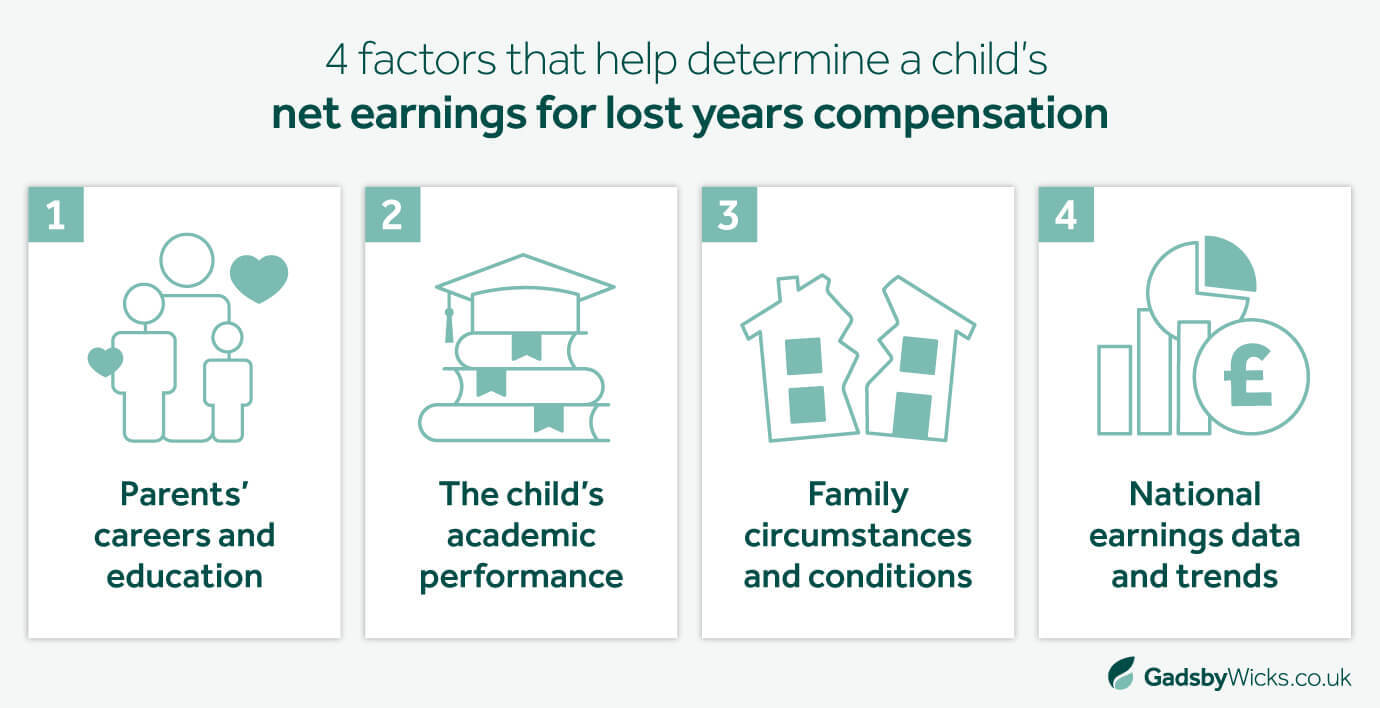
It is important to note that not every claim will automatically qualify for lost years damages, as courts will assess:
- Evidence of the child’s likely career path
- Educational background
- Family circumstances
- Statistical earning potential
Compensation is always determined on a case-by-case basis, and the strength of the supporting evidence will be crucial in calculating this figure.
Will the lost years ruling apply to previous child clinical negligence claims?
No. The Supreme Court’s ruling only applies to ongoing and future child negligence claims.
Medical negligence settlements are full and final. When a settlement is accepted, the claimant(s) sign a legal agreement confirming that the payment resolves the claim permanently. Claimants cannot return for more compensation, even after major legislation changes like this.
The only circumstances under which a claimant may return to court are when provisional damages are awarded. However, this must be agreed to or ordered at the time of settlement.
How are lost years' damages calculated?
In the UK, “lost years” compensation is usually calculated using the multiplier-multiplicand method used in personal injury law. This estimates the income someone would have earned during the years they will no longer live, adjusted to reflect real-life factors.
1. Estimate the claimant’s lost years
First, the courts will determine how many lost years the claimant will have by subtracting their post-injury life expectancy from “normal” life expectancy.
For example, if a child is expected to live until 35 post-injury, and was previously expected to live until 80, they would have 45 “lost years”.
2. Calculate the claimant’s likely net earnings in the lost years
Next, the courts will calculate what the claimant would likely earn during their lost years (usually after tax). For adults, this takes into account:
- Current salary
- Career trajectory
- Employment patterns
- Retirement age
- Tax and national insurance deductions
- Evidence from expert economists
For child claimants, this calculation is more complex, as they have no prior salary or earnings history. Instead, evidence used to calculate their earning potential will include:
- Their parents’ education and occupations
- Academic ability and school performance (if applicable)
- Expert educational or labour-market evidence
- Average national earnings and similar statistics
3. Deduct living expenses
When the net earnings are determined, the courts will then deduct a percentage that would have likely been needed for their personal living expenses (food, clothing, accommodation, etc.).
There is no one-size-fits-all value for this, but for claims involving children, this deduction may be as high as 50%.
4. Apply the “Ogden multiplier”
The remaining annual loss is then multiplied by the appropriate Ogden multiplier, taken from the latest Ogden Tables.
The multiplier converts the annual loss into a lump sum reflecting:
- Early receipt of damages (discount rate)
- Mortality risk
- Contingencies such as unemployment or illness.
Using the earlier example, 45 lost years may correspond to an Ogden multiplier of around 33.
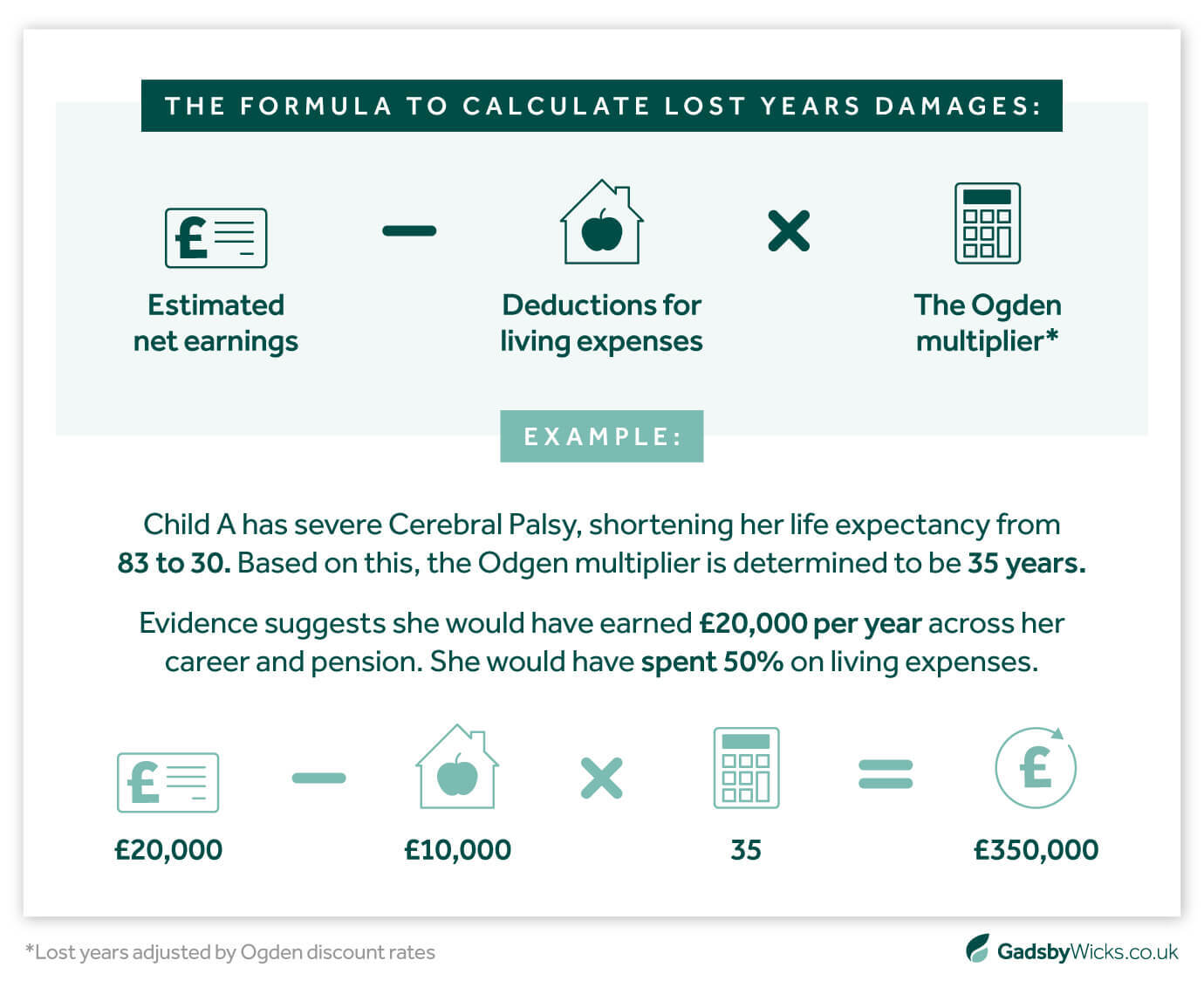
Please be aware that the formula above is only a top-line example of how lost years' compensation is calculated. Compensation in a medical negligence claim is determined on a case-by-case basis, with multiple factors influencing the final amount.
It may also be further adjusted using Ogden's “reduction factors”. These account for the probability that the claimant would be working during those years, based on factors such as:
- Disability status
- Education level
- Employment status at the time of injury
Of course, the Supreme Court ruling on lost years damages for children remains very recent. It may take time to determine a new approach to calculate compensation, something we are paying close attention to.
The rising cost of birth injury compensation
The decision to allow families to claim for lost years damages will heighten already tense discussions about the cost of birth injury cases.
In NHS Resolution’s Annual Report & Accounts 2024/25, birth injury claims already accounted for over half of the total value of clinical claims received (approximately £3.5B).
This will only add to that record figure. However, rather than use this as fuel for measures such as fixed recoverable costs (FRCs), which could limit access to justice for claimants, we hope that this motivates trusts to address the failings at the root of these tragic injuries.
As Paul Whiteing, chief executive of Action Against Medical Accidents (AvMA), said when asked about the Supreme Court’s ruling:
“This judgment will undoubtedly add to an already significant cost of clinical negligence. But as parliament’s public accounts committee recently said, preventing harm from happening in the first place is the most effective way to reduce the widespread impact of clinical negligence.”
How do I make a claim on my child’s behalf?
Now that you understand lost years damages and how they are calculated, you may be wondering how you can make a birth injury claim on your child’s behalf.
Anyone under the age of 18 cannot bring a claim forward themselves. Instead, they must be represented by a “litigation friend”.
A litigation friend can be anyone who will act in the claimant’s best interests – often a parent, guardian or close relative.
The litigation friend assumes the role of the claimant during the claim, working with their solicitors to answer questions and provide evidence. From there, the process is virtually the same as claiming as an adult, except compensation is awarded to the child.
The law requires that a litigation friend:
- Conducts all proceedings both fairly and competently
- Takes all decisions and actions for the benefit of the claimant
- Has no personal interest or stake in the claim
For more information about claiming on someone’s behalf, please watch this episode of the Medical Negligence Matters podcast.
Is there a time limit for a child’s clinical negligence claim?
The limitation period for most medical negligence claims in the UK is three years from your date of injury, or from the date you should have become aware of the injury (Date of Knowledge).
However, if the claimant is under the age of 18, they have until their 21st birthday to make a claim (three years from when they legally become an adult).
Furthermore, if the claimant lacks mental capacity, such as in a Cerebral Palsy negligence claim, then there is no time limit to bring a claim.
In all circumstances, we recommend pursuing a claim as soon as possible. This helps ensure that evidence and people’s memories of events stay fresh, offering the best support to your child’s claim.
Was your child injured by negligent treatment? Talk to the experts
The Supreme Court’s ruling in CCC v Sheffield Teaching Hospitals NHS Foundation Trust greatly changes how birth injury compensation will be calculated in the future.
With financial losses due to reduced life expectancy now included within these calculations, this ruling corrects an injustice that has persisted for over four decades, and ensures future claimants will be compensated on the same level as adults.
We understand that no amount of money can truly compensate a person whose life is shortened through no fault of their own. But our specialist clinical negligence solicitors work tirelessly to help families find answers for what happened, and secure the financial support needed to make the future as comfortable as possible.
If you believe that your child was injured through an avoidable medical mistake, we are here for you. As a no-win, no-fee medical negligence firm, you won’t pay a penny unless we win your case.
Get answers. Get closure. Get justice. Start your claim today with our experienced birth injury claim solicitors.
Disclaimer
All content contained within this article is meant for general information only – this should not be treated as a substitute for medical advice from your doctor or another healthcare provider. If you require legal advice specific to your situation, please contact our team directly.
Gadsby Wicks is not liable for any diagnosis made from the content of this article, nor does it endorse any service or external site linked to within the article.
Always consult your GP if you are concerned about your health and wellbeing, or speak to us if you require legal advice.
Do you have a negligence claim?
Meet our medical negligence claims solicitors
Related Insights