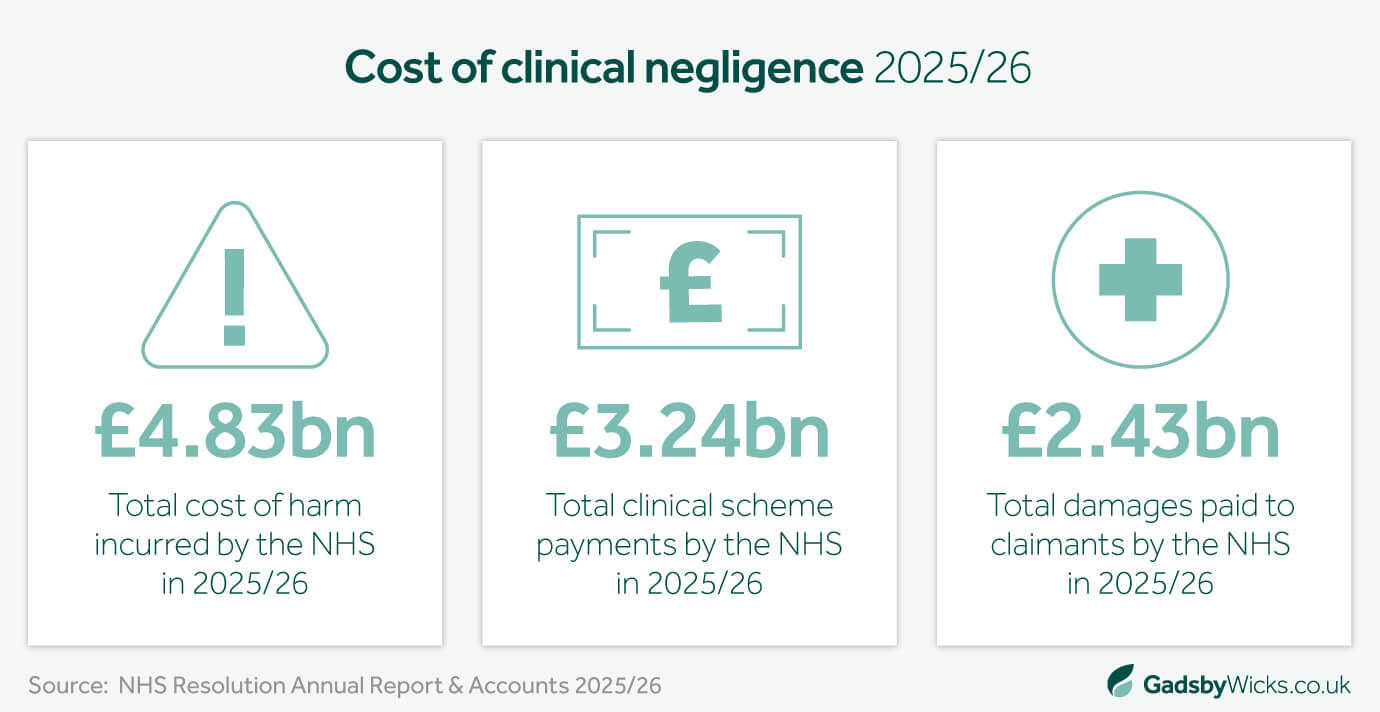
The growing cost of clinical negligence has been a serious talking point for decades. With the overall cost of harm in the NHS at £4.8 billion according to the latest NHS Resolution Annual Report & Accounts, this conversation shows no sign of slowing down.
Fixed Recoverable Costs (FRCs) have been explored as a way to limit the litigation costs associated with clinical negligence claims, as they have for personal injury claims and other types of civil cases. But are FRCs an effective tool for keeping costs down, or do they come at the expense of people’s pursuit of justice?
Here, we explain what FRCs are, dive deeper into the debate surrounding them, and share our thoughts on both their existing and potential usage in clinical negligence cases.
Understanding Fixed Recoverable Costs in clinical negligence claims
Fixed Recoverable Costs (FRCs) are predetermined legal costs that the winning party can claim from the losing party in a civil litigation claim. This is governed by CPR Part 45 (the Civil Procedure Rules) in England and Wales.
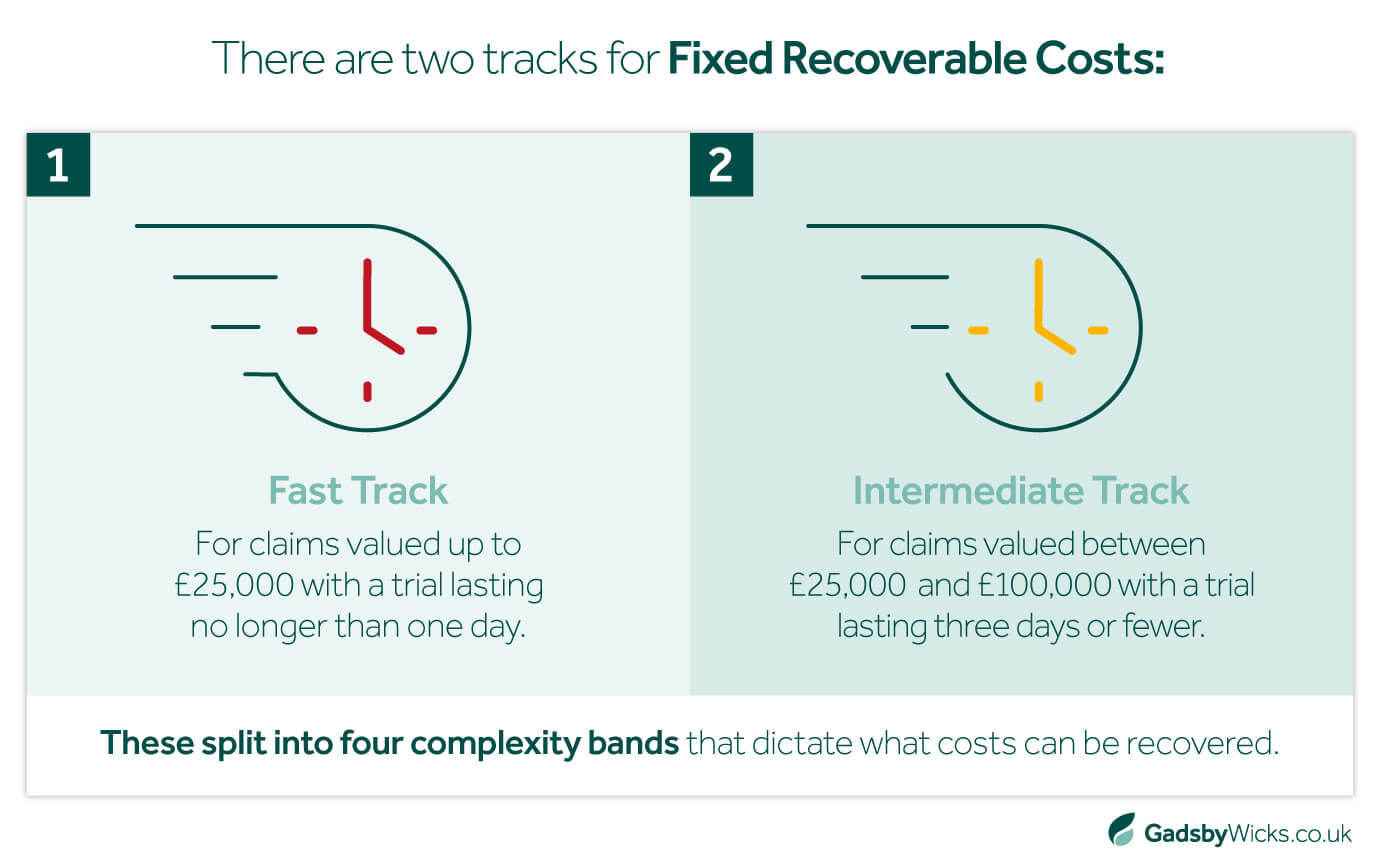
FRCs essentially put a cap on how much money the winning side in a claim can recover from the losing side to cover their legal fees. They apply to most civil claims valued up to £100,000, divided into two distinct procedural tracks:
Claims valued in excess of £100,000, known as Multi-Track claims, are almost always exempt from FRC. Furthermore, there are some exceptions where claims valued under £100,000 are exempt from FRCs:
Cases that are legally suitable for the Multi-Track regardless of their value (e.g. clinical negligence, mesothelioma/asbestos claims, abuse of children/vulnerable adults)
Residential housing claims
Cases involving protected parties (children or people lacking mental capacity)
Nevertheless, in most civil claims valued at under £100,000, FRCs have become a staple to limit how much the “losers” in a claim must pay toward the winners’ legal costs.
Fixed Recoverable Costs and clinical negligence: A brief timeline
The conversation around Fixed Recoverable Costs and clinical negligence stretches back to 2017, when Sir Rupert Jackson proposed extending FRCs to a wider range of civil claims in his costs review.
When the Ministry of Justice's FRC reforms took effect in October 2023, it was stated that clinical negligence claims could be subject to FRCs under the Intermediate Track.
But this could only happen if the defendant admitted both breach of duty and causation in their letter of response. If they did not admit to either, the clinical negligence claim would likely be treated as a Multi-Track claim.
Since then, there have been several proposals to introduce FRCs for “lower-value” clinical negligence claims (valued between £1,501 and £25,000), with this scheme seemingly set to start in April 2024. However, this was postponed and, as of the time of publishing, this is still yet to be actioned.
More recently, this conversation was reinvigorated with the Clinical Negligence Bill proposed by Catherine McKinnell MP, which included an intent for:
“the provision for a fixed recoverable costs scheme to limit the costs that may be recovered in respect of certain cases of clinical negligence”
The Clinical Negligence Bill underwent its First Reading in the House of Commons in March 2026, but is yet to progress beyond this (at the time of publishing).
Addressing the growing cost of clinical negligence
Do Fixed Recoverable Costs deny access to justice?
As experienced clinical negligence solicitors, we understand the legal costs associated with these claims better than anyone. Litigation is an expensive business, and we absolutely agree that action is required to prevent the cost of clinical negligence from spiralling further.
However, we do not accept cost-saving measures that may compromise access to justice – and we believe Fixed Recoverable Costs risk doing exactly that.
Complexity ≠ value
First and foremost, how complex a claim is does not always equate to its value.
Claimants can have very extensive medical histories that solicitors and independent experts must thoroughly scrutinise. This can be true whether their claim is valued at £50,000 or £5 million.
However, the more complex a claim, the more time, resources and experts it takes to establish a case. This incurs costs – and FRCs limit how much of these costs the defendants pay based on the value of the claim.
So who pays the rest if the defendants’ payment does not cover the full legal costs? That burden would fall either on the claimant, who may not have the means to pay those fees, or their solicitors.
This puts solicitors in a tough predicament for complex, lower-value claims. They either:
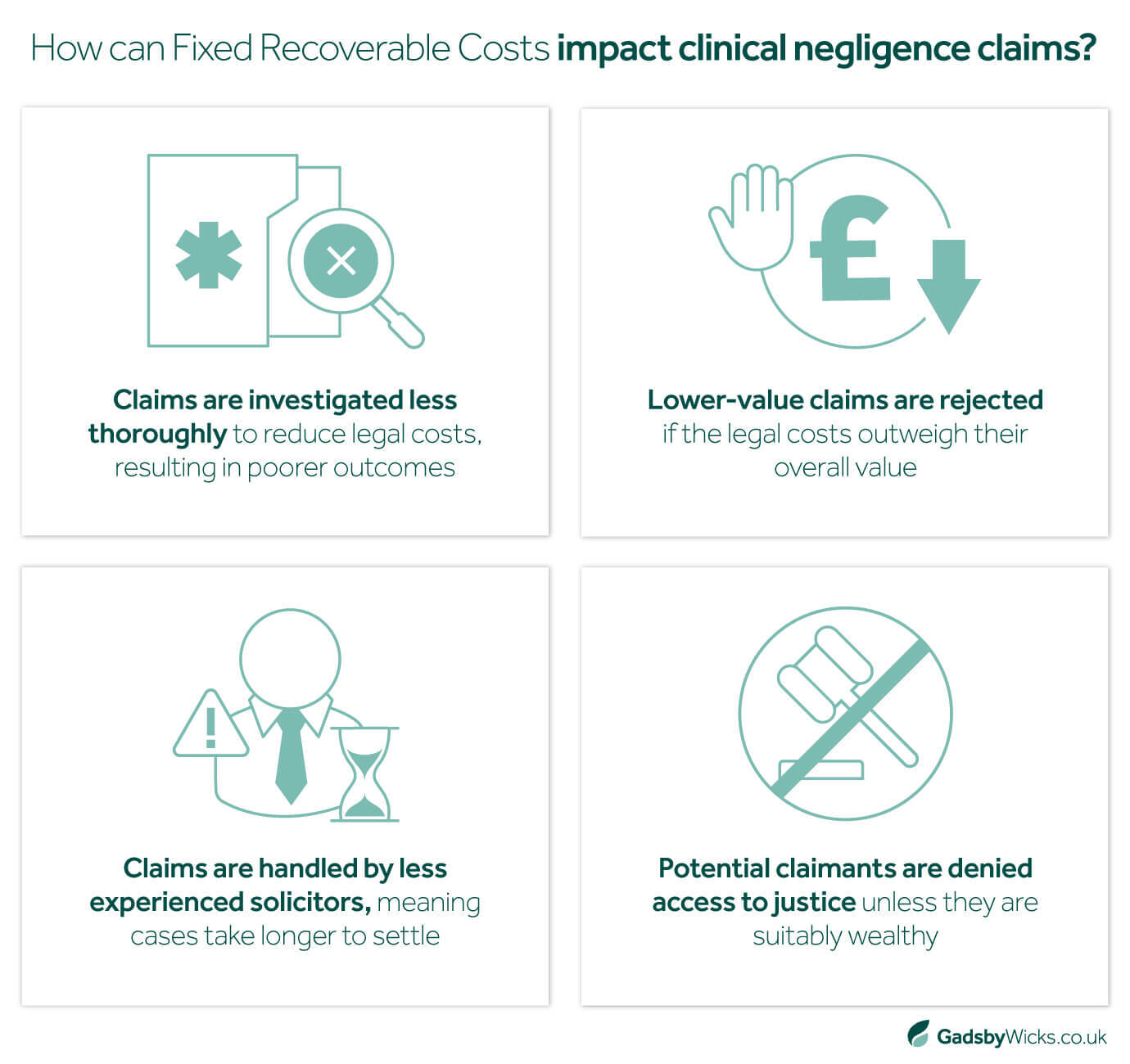
Cut corners when investigating the claim, such as spending less time reviewing medical records or not requesting an expert report, which weakens the case and leads to worse outcomes; or
Only pursue these cases if the client is wealthy enough to pay the excess legal costs, and refuse those who cannot
Neither scenario is beneficial for the claimant or their lawyers. Limiting recoverable costs for more modest claims risks seriously undercompensating people if you cannot investigate claims properly, or means that justifiable cases are refused altogether.
This matters because the burden of proving negligence sits entirely with the claimant. Building a watertight case requires proper, professional investigation – shortcuts mean lower settlements, or cases failing outright.
FRCs risk making that level of investigation less affordable, denying access to justice to those who deserve it.
FRCs and access to justice
Overall, we are concerned that FRC proposals will form a barrier for those who suffered negligent treatment, but lack the means to pay their own legal fees.
Yes, this would help address the costs of clinical negligence, but only by potentially denying justice to hundreds, if not thousands, of people with more modest claims. Because, despite what media headlines may indicate, most medical negligence claims settle in the lower five-figure range.
From our perspective, the risk is not worth the reward – we cannot compromise access to justice for all for the sake of reducing legal costs.
What are the alternatives to Fixed Recoverable Costs?
If Fixed Recoverable Costs are not the answer to the increasing cost of clinical negligence, then what is?
Reducing the number of negligence claims
The most obvious solution is better preventing the negligence that leads to these claims. NHS Resolution’s report revealed that the NHS received 15,236 clinical negligence claims in 2025/26 – 5.6% more than in the previous year.
Putting greater emphasis on patient safety and treatment must be the long-term solution for reducing the frequency and cost of these claims. But another route to minimising costs is to ensure claims are not fought beyond the point that they should be.
Earlier admissions of liability
While many claims merit some back-and-forth discussion, many others are clearer-cut, yet defendants prolong the process.
Earlier admissions of liability have proven to significantly reduce legal fees, not just by shortening the process, but by letting both sides' representatives work together on a fair resolution from the outset.
Even the most hardened litigators agree that collaboration is the right way to get the best and fairest result for the client.
Prioritising specialist solicitors
More emphasis should also be placed on instructing specialist solicitors on both sides of a claim.
Cost pressures mean more claims are now handled by less experienced, non-specialist lawyers. But this is a false saving, since unfamiliarity with the process often drags cases out longer than necessary.
Specialist clinical negligence solicitors manage claims more efficiently, delivering better results for clients and, in turn, keeping costs down.
Get expert advice from the medical negligence specialists
We don’t expect the conversation around Fixed Recoverable Costs in clinical negligence to disappear anytime soon, and we will be watching the progress of the Clinical Negligence Bill closely in the coming months.
But as firm proponents for access to justice for everyone, we remain sceptical that FRCs are the right way forward to tackle the cost of clinical negligence, at least in its current iteration.
As No Win, No Fee claims solicitors for over 30 years, we believe that anyone injured due to negligent treatment deserves the right to secure compensation and find answers. You pay nothing upfront when we take on your case, and you owe us nothing unless your claim is successful.
Have you or someone you love suffered negligent care? Start your claim with us today, or contact us for direct, professional advice.
Tell us about your claim: what happened, when and where it took place. Your submission will be personally reviewed by one of our experienced Nurse Advisors; trained professionals who will contact you to support you through the next steps of your claim.



 Back to top