- No win. No fee.
- No hidden costs
- 100% risk-free, only pay if you win
- Home >
- Insights >
- Misdiagnosis Claims >
- Atrial fibrillation misdiagnosis and preventable stroke claims: What you should know
About the Author
Alan Mendham
Medical Negligence Solicitor and Partner - LLB (Hons) University of East London
Read more about Alan »Strokes are among the most serious medical emergencies in the UK. Responsible for around 38,000 deaths each year, stroke injuries can have life-changing repercussions, from long-term physical disability to loss of independence, emotional difficulties, and profound impacts on families and carers.
Meanwhile, atrial fibrillation (often shortened to AFib or AF) makes the risk of a stroke up to five times greater than normal, and AF-related strokes are often more serious than other strokes, with higher mortality and disability rates.
Therefore, when atrial fibrillation is misdiagnosed or poorly managed, it can directly cause patients to stroke – endangering their capabilities and their lives.
Through this guide, you will understand the relationship between atrial fibrillation and strokes, and how atrial fibrillation negligence can be at the heart of a patient’s stroke.
Understanding atrial fibrillation misdiagnosis and stroke claims
- What is atrial fibrillation?
- How does atrial fibrillation increase the risk of a stroke?
- What can cause a missed atrial fibrillation diagnosis?
- What is a failure to manage atrial fibrillation?
- How can these failures result in a preventable stroke claim?
- How do I make a stroke negligence claim?
- Were you harmed by a preventable stroke?
What is atrial fibrillation?
Atrial fibrillation is a common form of heart rhythm problem (arrhythmia) where your heartbeat does not remain steady.
During AF, the atria (top chambers) of your heart beat irregularly, interrupting the flow of blood into the body. Because the atria don’t contract properly in AF:
- Blood can pool and form clots in the heart
- Clots can travel to the brain and cause a stroke
- The heart may weaken over time, leading to heart failure
While there is no cure for atrial fibrillation, treatments such as medications to control the heart rate, blood thinners to reduce stroke risk, and electrical cardioversion to rest the heart’s rhythm, help prevent AF from evolving into more serious conditions.
What are the symptoms of atrial fibrillation?
There is a lengthy list of symptoms associated with AF, including (but not limited to):
- Irregular heartbeats and unsteady pulse
- Sudden sensation of your heart pounding, racing or palpitating
- A heartbeat that is over 100 beats per minute
- Fatigue and tiredness
- Chest pain or tightness
- Feeling short of breath or lightheaded
However, sometimes it presents no symptoms, which can make it more challenging for healthcare professionals to diagnose.
How does atrial fibrillation increase the risk of a stroke?
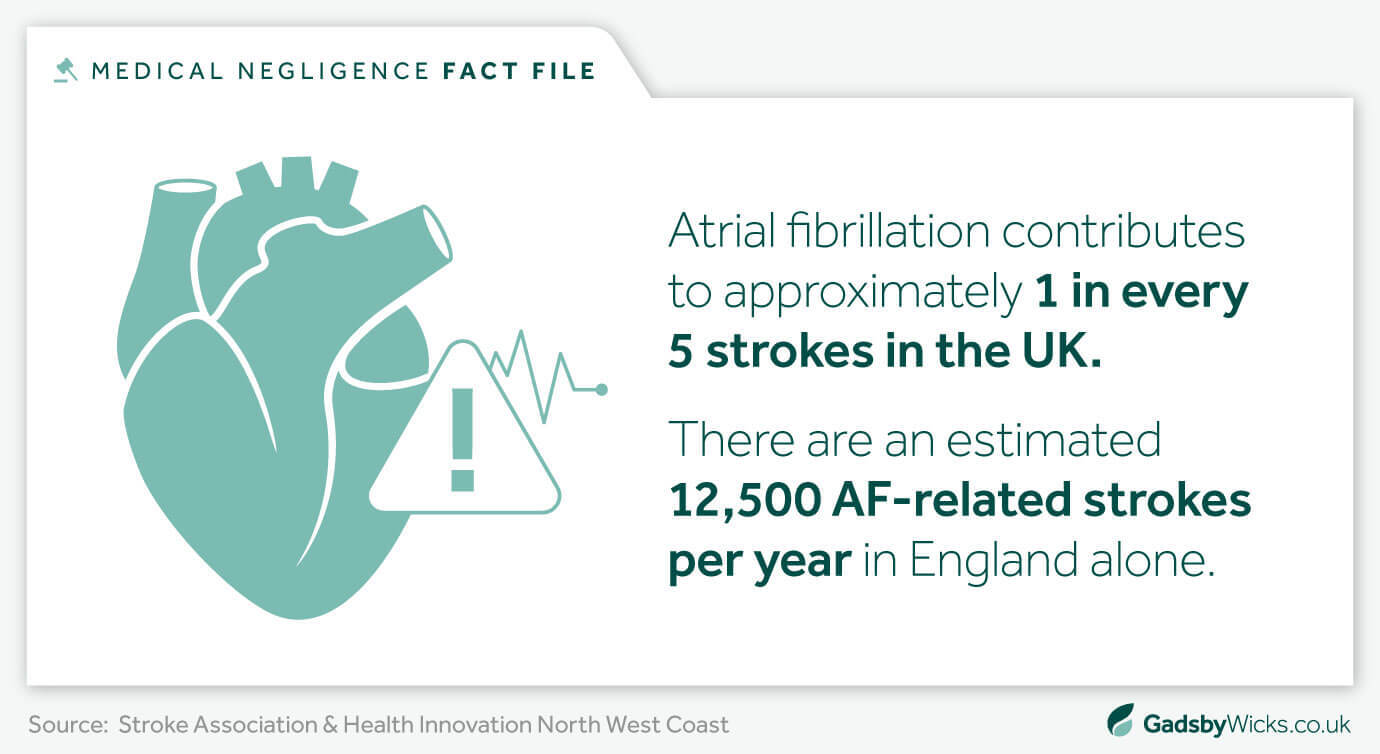
As noted at the start, someone with atrial fibrillation is five times more likely to suffer an ischemic stroke than someone without it. Furthermore, AF contributes to roughly one in every five strokes in the UK each year.
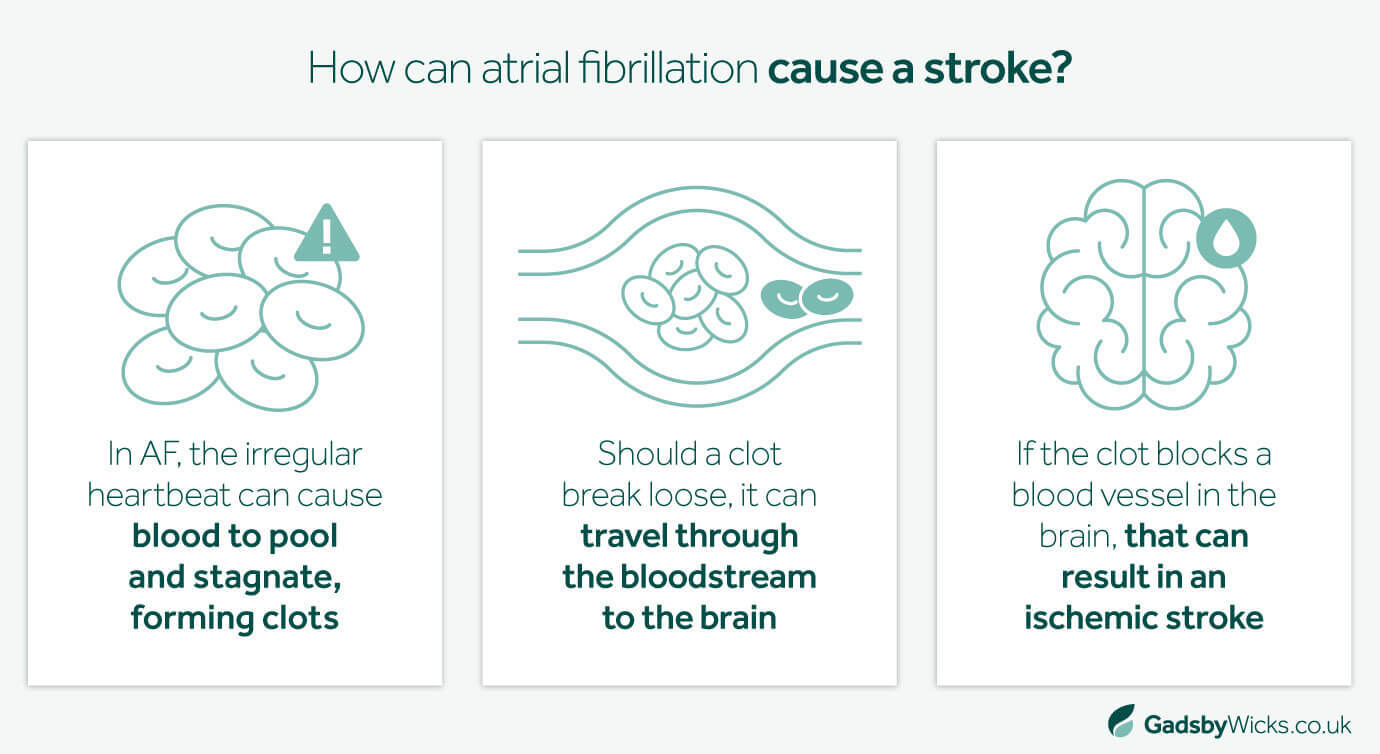
How does this happen? The irregular heartbeat caused by AF allows blood to pool in the heart, where it stagnates and forms clots (especially in the heart’s grooves).
If a clot breaks loose, it can travel via the bloodstream towards the person’s brain. The clot could then block a blood vessel in the brain, cutting off oxygen and causing an ischemic stroke.

Atrial fibrillation not only makes strokes more likely and frequent, but it can also make strokes more dangerous. Indeed, AF-related strokes have a noticeably higher mortality rate and disability rate than those unrelated to AF.
In summary, having atrial fibrillation greatly increases the risk of developing a stroke. And, if the atrial fibrillation is missed, misdiagnosed or mismanaged, the risk grows even further.
What can cause a missed atrial fibrillation diagnosis?
Although there is no cure for atrial fibrillation, there are multiple steps that can be taken to reduce the chances of this causing strokes, blood clots and heart failures:
- Beta blockers and similar medications can help control the rate and rhythm of someone’s heart
- Anticoagulants minimise the risk of blood clots forming, in turn reducing the risk of one causing a stroke
- Ablation, or burning, freezing or using high-energy electrical pulses to destroy the relevant section of your heart
- An electrical cardioversion, which uses electricity to reset your heart rhythm
- A pacemaker or an implantable cardioverter defibrillator (ICD) helps to maintain the rhythm and safety of your heart
However, if atrial fibrillation is misdiagnosed or overlooked, it may mean these critical treatments are not administered. Without at least some of the steps above taken, the chances of developing a life-changing stroke injury grow noticeably.
So, what may result in missed AF, leading to a stroke?
Symptoms not investigated
First, a GP or doctor may fail to identify some of the standout symptoms of atrial fibrillation, like heart palpitations or breathlessness.
If these are overlooked entirely or not investigated thoroughly, the techniques and medications used to prevent a stroke may not be applied, increasing the odds of an incident.
Symptoms attributed to ageing or anxiety
Atrial fibrillation shares many symptoms with numerous other illnesses, including symptoms of ageing and anxiety. In fact, this frequently happens to women who are living with atrial fibrillation, as it is rarer for women to have this condition.
Due to AF’s crossover with many other types of illness, it can mean a patient is incorrectly treated for the wrong condition, while the AF is allowed to progress.
Failure to perform an ECG
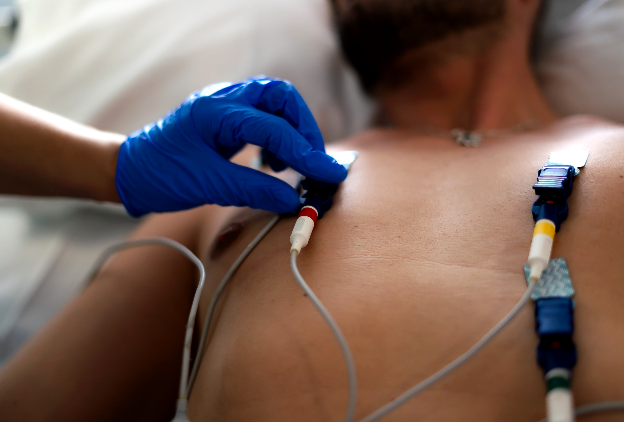
An ECG or electrocardiogram tests the electrical activity of the heart, meaning it should easily be able to identify any irregularities in a person’s heartbeat.
Failure to conduct an ECG, or not following up on abnormal ECG test results, can again let atrial fibrillation grow without any restriction.
Poor monitoring of AF progress
When you are diagnosed with atrial fibrillation, you are scheduled for regular check-ups to review its progress and ensure your symptoms are kept under control.
If this monitoring is inadequate, or developments are overlooked at a check-up, then opportunities to prevent dangerous blood clots from forming could be missed.
Failure to act on an irregular heartbeat
Should your GP, doctor or cardiologist identify an irregular heartbeat, but then fail to act on this or attribute it to another cause, this can once again allow your atrial fibrillation to proceed untreated, increasing the likelihood of causing a stroke.
Misinterpreting or misfiling test results
Finally, misinterpreting or misplacing any test results, be it after an echocardiogram, chest x-ray or blood test, can mean your condition is misdiagnosed.
What is a failure to manage atrial fibrillation?
Failing to manage a patient’s atrial fibrillation appropriately is equally as negligent as a missed diagnosis or a delayed diagnosis. This means that although your healthcare providers are aware of your condition, they are not taking suitable steps to minimise the risk of your condition causing a stroke.
These examples of atrial fibrillation negligence include:
- Failure to use suitable scoring tools to assess the stroke risk
- Failure to prescribe anticoagulants, beta blockers or other medication
- Administering the incorrect anticoagulant dosage or strength
- Failure to refer the patient to cardiology for further tests
- Failure to competently warn patients about the risk of a stroke
- Lack of follow-up or medication review over time
Any or all of the above could be a catalyst that allows for blood clots to form and enter a patient’s bloodstream, causing a completely preventable stroke.
For more examples, please refer to our page on cardiac negligence claims.
Who could be responsible for missed or poorly managed atrial fibrillation?
All clinicians owe their patients a duty to diagnose and manage atrial fibrillation to a standard of care that is reasonable and acceptable. Examples of healthcare professionals who may be responsible for a misdiagnosed or poorly managed atrial fibrillation include:
- GPs and hospital doctors
- A&E clinicians
- Cardiologists
- Nursing staff
- Surgeons
This applies to both NHS trusts and private hospitals, and multiple healthcare professionals may share responsibility for what happened.

How can these failures result in a preventable stroke claim?
If your atrial fibrillation was misdiagnosed or poorly managed, and this caused you to suffer a stroke, you likely have the right to make a stroke negligence claim.
However, please note that for any medical negligence claim to be successful, it must meet three important criteria:
1. Duty of care in preventable stroke claims
First, the healthcare professional treating you must have owed you a duty of care. This is typically just a formality, as any clinician who provides you with treatment takes on a duty of care.
2. Breach of duty in preventable stroke claims
Next, you must prove that your healthcare provider breached their duty of care to you. In practice, this means you must show that either no responsible body of doctors would regard the treatment as acceptable, or if there are, then the practice does not withstand logical analysis.
3. Causation in preventable stroke claims
Finally, you must demonstrate that your healthcare provider’s breach of duty directly caused you to suffer a stroke.
This is often the most complex element to prove, as your solicitor must consider whether you would have sustained a stroke regardless of any negligence. However, causation only needs to be proved against the Balance of Probabilities (or more likely than not).
Furthermore, you do not need to prove that the breach of duty was the sole cause (or even the main cause) of your stroke. You only need to demonstrate that it made a material contribution towards your stroke.
If your case meets all three criteria, then you have a valid stroke negligence claim, and can pursue the compensation, answers and justice you are owed.
How do I make a stroke negligence claim?
If you or a loved one suffered an avoidable stroke due to a misdiagnosed or untreated atrial fibrillation, here is a brief guide to help get you started on making a claim.
Preliminary steps
Before reaching out to a medical negligence firm, we encourage you to take these initial steps to best support your wellbeing and help prepare you for your first meeting with a legal expert:
- Seek medical care for you or your loved one’s condition
- Request your medical records from your GP or hospital
- Get clarification on what symptoms were reported and how they were handled
- Document the impact of the stroke on your daily life
Contacting a solicitor
Next, reach out to a dedicated medical negligence solicitor. With many options available, we advise you to prioritise the following when deciding who to represent you:
- A proven track record of success, especially in stroke and cardiac negligence claims
- Accredited by reputable industry bodies, such as The Law Society and APIL
- A guaranteed “No Win, No Fee” approach to stroke claims, where you are in no financial risk at any stage
- A significant proportion of claims settled before cases proceed to court
When you contact our specialists at Gadsby Wicks, you will first meet with our experienced nurse advisers, who will ask about your situation and take notes for our legal team.
Our senior partners will then review your case. If we believe your claim is valid, you will be assigned one expert solicitor who will manage your case from start to finish. This allows you to build a trusted relationship with one professional, who will explain every step of the process and be available to answer any questions you may have.
If you would like to learn more about making a stroke negligence claim, please read our legal process guide.
What evidence is needed to prove a stroke negligence claim?
A stroke negligence claim lives or dies on the strength of the evidence presented. As highly experienced solicitors, we understand what evidence is required, who to contact, and how to gather it in the most efficient manner possible.
Evidence we may use to prove your stroke negligence claim includes:
- Medical records
- ECG test results
- Medication and prescription records
- Stroke imaging scans
- Witness statements
- Financial records
- Independent medical expert reports
Independent medical experts are especially important to prove stroke negligence. Their reports are key to demonstrating that your healthcare providers fell below an acceptable standard of care, and determining that your stroke was caused by their negligence.
Through our extensive network of medical experts, we will reach out to the most relevant professionals to assess your case, so you can secure the maximum amount of compensation.
What is the limitation period to make a stroke negligence claim?
In most cases, you have a three-year time limit from the date you became aware of your injuries (the Date of Knowledge) to make a claim. However, there are exceptions:
- Claimants aged 18 or younger have until their 21st birthday
- There is no time limit for claimants who lack mental capacity
- If the claimant passes away during their claim, the three-year limitation period restarts from their date of death
Of course, it is preferable to start your claim as soon as possible, as it means evidence and people’s memories are fresher than if you waited additional months or years.
Were you harmed by a preventable stroke?
We hope this guide has helped you understand how a misdiagnosed atrial fibrillation can cause a stroke, and how you can pursue a claim if you or someone you love sustained a long-term disability after a stroke.
At Gadsby Wicks, we have represented thousands of clients through the claims process, and recovered millions in compensation. Working with you every step of your journey, we will help you find closure after what happened to you, and secure your family’s financial future.
- Over £300 million recovered in compensation
- Over 5,000 claimants supported on the path to justice
- 96% of claims settled before entering a courtroom
- No win, no fee medical negligence – you pay nothing unless we win your claim
Start your claim now by completing our short questionnaire, or contact us directly to explore your legal options.
Disclaimer
All content contained within this article is meant for general information only – this should not be treated as a substitute for medical advice from your doctor or another healthcare provider. If you require legal advice specific to your situation, please contact our team directly.
Gadsby Wicks is not liable for any diagnosis made from the content of this article, nor does it endorse any service or external site linked to within the article.
Always consult your GP if you are concerned about your health and wellbeing, or speak to us if you require legal advice.
Related Insights
The emotional impact of a cancer misdiagnosis