- No win. No fee.
- No hidden costs
- 100% risk-free, only pay if you win
- Home >
- Insights >
- Birth Injuries >
- Vaginal mesh compensation claims: Your essential guide
About the Author
Jessica Wright
Medical Negligence Solicitor - LLB (Hons) Anglia Ruskin University
Read more about Jessica »From the 1990s until the late 2010s, vaginal mesh implants and pelvic mesh implants were considered the gold standard for treating stress urinary incontinence (SUI) and pelvic organ prolapse (POP) in women.
Today, their use is far less frequent, following widespread concerns and the highly influential “First Do No Harm” report in July 2020, and is limited to exceptional circumstances under strict supervision.
However, pelvic mesh complications continue to affect thousands in the UK. Some reports suggest that up to one in six patients were negatively impacted by transvaginal mesh implants, while advocacy groups such as Sling the Mesh continue to campaign for women permanently injured by these devices.
In this essential guide, we explain what vaginal mesh implants are, the complications they have inflicted on many women in recent years, and how you may claim compensation if mesh implants injured you or someone you love.
Explaining vaginal mesh compensation claims
What are vaginal mesh implants?
Vaginal mesh implants, also called transvaginal mesh implants, are synthetic medical devices designed to strengthen the walls of a patient’s vagina.
These implants were used to primarily treat two common conditions brought on by ageing, childbirth or pregnancy:
- Stress urinary incontinence (SUI): Involuntary leakage of urine after physical exertion, such as coughing, sneezing, laughing or exercising.
- Pelvic organ prolapse (POP): Where organs like the bladder, uterus or bowel sag into the vagina due to a weakened pelvic floor.
SUI affects approximately 20% of women after childbirth or menopause, while POP impacts around half of mothers.
Various types of vaginal mesh, including TVT (tension-free vaginal tape) and TVTO (tension-free vaginal obturator), became a go-to treatment for these conditions. Between April 2008 and March 2017, over 100,000 NHS patients underwent a tape insertion procedure for SUI, while 27,016 patients had a mesh procedure for POP.
For many patients, it greatly alleviated the symptoms of these conditions. However, the safety and effectiveness of vaginal mesh were regularly criticised even before their use was suspended in 2018.
Other types of mesh implants
In addition to transvaginal mesh implants, several other types of mesh implants were once regularly used to treat similar conditions as SUI and POP, including:
- Rectal mesh implants to treat rectal prolapses
- Pelvic mesh implants to prevent prolapses in the bladder, uterus, rectum, vagina and urethra
Like vaginal mesh implants, these were widely used, but were also heavily scrutinised over long-term safety concerns.
Understanding transvaginal mesh complications
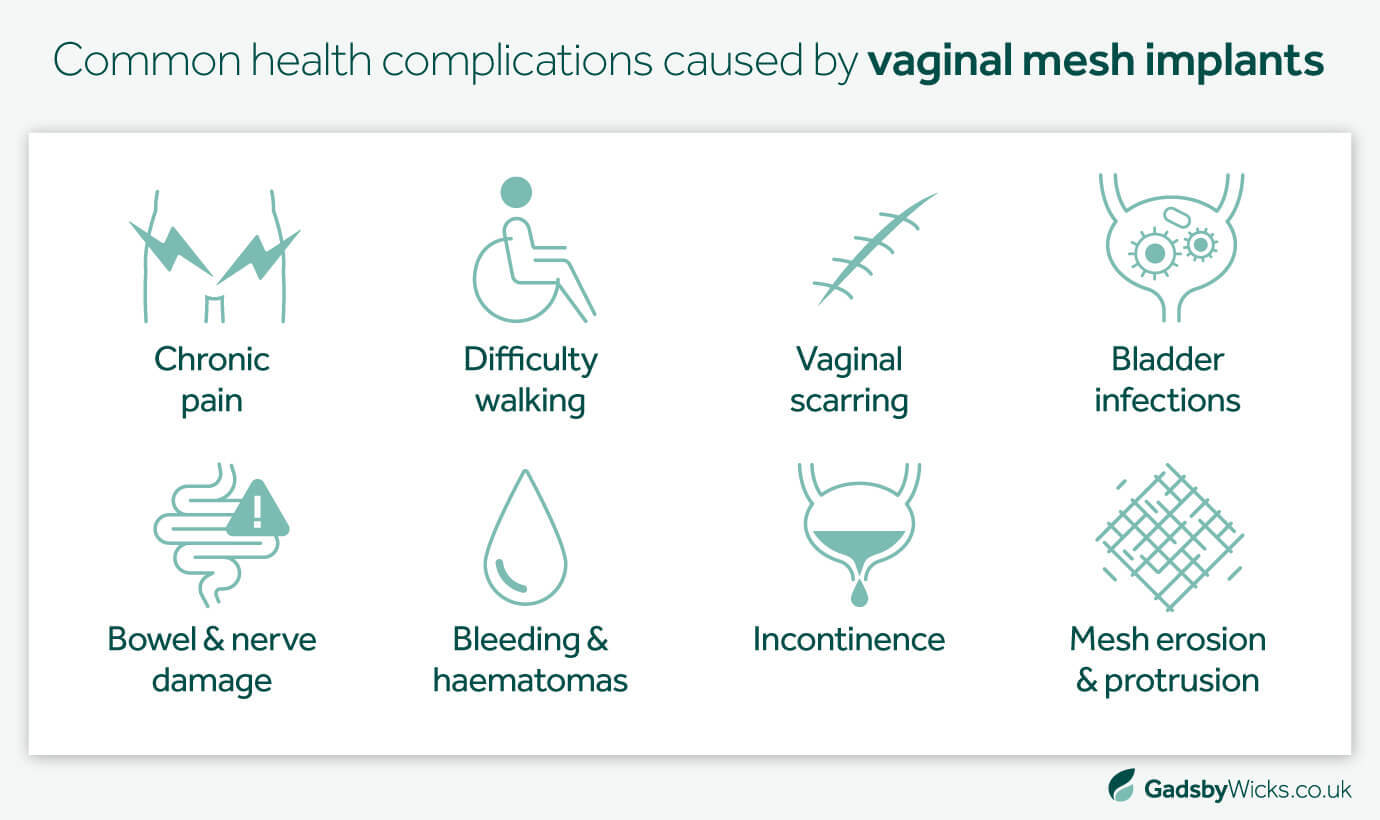
Despite their widespread usage between the late 1990s and 2017, many patients began to experience serious, and in multiple cases, irreversible complications. These include:
- Chronic pain in the pelvis, abdomen, lower back and legs
- Difficulty or inability to walk
- Vaginal scarring and erosion
- Bleeding and haematomas
- Bladder infections and perforations (punctures)
- Injuries to the bowel and nerves
- Organ damage
- Incontinence
- Painful sexual intercourse
- Mesh erosion or protrusion (where implanted mesh material moves out of place)
These and other issues were flagged in the “First Do No Harm” report and subsequent 2024 Hughes report, resulting in the greatly restricted use of meshes today. Since 2013, the National Institute for Health and Care Excellence (NICE) guidelines have made it necessary to offer physiotherapy and less invasive treatments before offering vaginal mesh.
However, it is still a prominent issue, as in numerous cases complications do not arise until several years after the mesh was implanted.

What can lead to a vaginal mesh negligence claim?
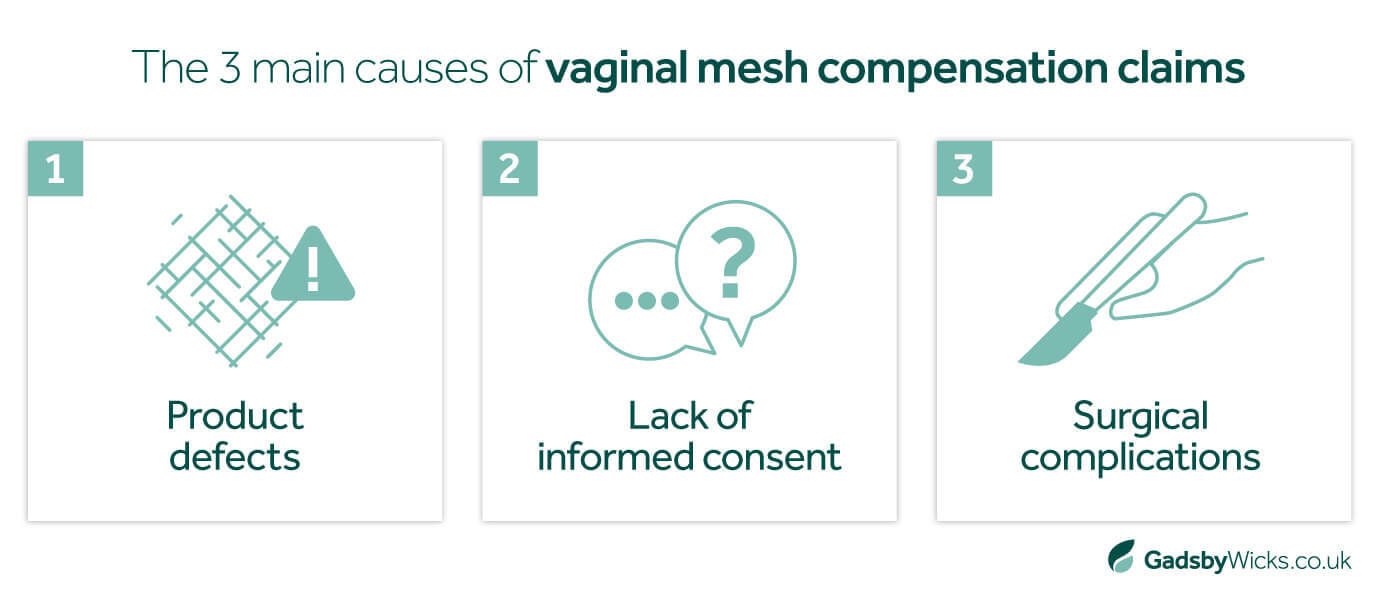
Incidents of vaginal mesh negligence typically fall into one of three broad categories:
1. Defective medical device claims
Complications may have occurred if the transvaginal mesh used was improperly designed, made from inappropriate materials, or if the manufacturer was not clear about the risks associated.
In these circumstances, the manufacturer of the vaginal mesh would be the subject of the claim, rather than the healthcare providers who implanted the device.
A famous example of this was in 2024, where a group claim from 140 women reached a settlement with Johnson & Johnson, Bard and Boston Scientific after suffering traumatic complications from their implants.
2. Lack of informed consent negligence claims
Many vaginal or pelvic mesh medical negligence claims are based on patients not being properly informed about the risks attached to these devices.
Informed consent is a fundamental patient right, stating that patients have the right to know all risks and benefits of a procedure. In vaginal mesh compensation claims, many women have stated that they were not adequately informed of the potential consequences.
If your surgeon or another healthcare professional did not discuss:
- The risks of implanting a vaginal mesh device, or of the surgery itself;
- The long-term implications of undergoing surgery;
- How long your hospital stay and recovery period would be;
- Advice on managing your condition post-surgery;
- Any alternative treatment options for your condition;
Then you may be entitled to pursue a mesh compensation claim for lack of informed consent.
3. Surgical mesh injury compensation claims
Finally, your injuries may have been sustained during surgery to insert the vaginal mesh implant, or complications during revision mesh surgery to remove the implant.
Examples of surgical negligence may include:
- Mistakenly cutting an incorrect nerve or blood vessel
- Performing surgery on the wrong part of the body
- Failure to check that actions were performed correctly
- Failure to monitor a patient’s heart rate and breathing
- Using too much or too little anaesthetic
- Poor post-surgical aftercare and monitoring
Not every surgical mistake will be considered negligent, so it is important to work with specialist medical negligence solicitors in the UK to determine whether your surgeons performed below an acceptable standard.

Your guide to making a vaginal mesh compensation claim
Any woman who has suffered complications from a vaginal mesh implant may potentially claim compensation.
If you believe that you suffered because you were ill-informed of the risks associated with these procedures, or due to mistakes during surgery, here we outline some of the most important information about pursuing a claim.
How do I prove that transvaginal mesh complications were due to negligent treatment?
Like any medical negligence claim, proving negligence depends on the answers to three key questions:
- Did your healthcare provider breach their duty of care to you?
- Did you suffer pain, injury, loss or damage during your treatment?
- Was your suffering directly caused by the breach of duty?
A successful claim must satisfy all three of these criteria. Furthermore, you must be able to prove that the injuries you endured were greater than what would have occurred if you had never undergone the procedure at all.
As specialists in gynaecology negligence claims, we will investigate a wide range of evidence to prove whether your injuries were the result of negligence, including:
- Medical records
- Personal and witness statements
- Photographs and visual evidence
- Financial documents
- Independent medical expert reports
Through our highly attentive investigations and established network of impartial, suitable medical experts, we will build a watertight case if your suffering was due to negligence.
What happens if my vaginal mesh surgery happened years earlier, but complications only started recently?
For many women affected by transvaginal mesh complications, symptoms did not start until several years after they underwent surgery. However, this delay does not jeopardise your ability to make a claim.
While there is a three-year time limit to launch a medical negligence claim, this does not start until a person should have been aware of their injuries, known as the Date of Knowledge.
For example, this may mean going to your doctor or GP about chronic pain in your pelvic region, who then informs you that your vaginal mesh may be the cause. Only then would the three-year limitation period begin.
Can I claim if my vaginal mesh implant surgery was performed in a private hospital?
Yes. You can make a claim against a private healthcare provider in the same way that you may make an NHS mesh compensation claim.
The only notable difference is who pays any compensation recovered; NHS Resolution handles this on behalf of all NHS trusts, while private hospitals will be covered by their insurers.
What compensation could I recover for a vaginal mesh compensation claim?
There is no average compensation settlement for a vaginal mesh implant claim. The value can vary significantly based on the injuries sustained and the impact they had on your life.
However, we can share that medical negligence compensation is divided into two areas:
- General damages for your pain, suffering, and loss of amenity (PSLA).
- Special damages for out-of-pocket expenses that you incurred or will incur in the future, including loss of earnings, treatments, medical aids, home adaptations and more.
Over the past five years, Essex-based NHS trusts have paid approximately £4 million in compensation for patients affected by gynaecological negligence; nationally, the total is over £91 million.
Through our investigations, we will be able to provide you with a strong estimate of how much you could recover from your vaginal mesh compensation claim.
Where should I start with my vaginal mesh compensation claim?
At Gadsby Wicks, after completing our simple online questionnaire, you will be contacted by one of our dedicated nurse advisers. They will listen to your story and answer any questions you have, before presenting your claim to our team of solicitors.
If we believe you have a valid claim, you will be assigned one solicitor to manage your claim from beginning to end, ensuring you have a consistent, experienced professional overseeing your case at all times.
From here, we will guide you through every stage and keep you informed with regular communication, making the claims process as straightforward and comfortable as possible.
Furthermore, as a no-win, no-fee medical negligence firm, you will not be expected to pay anything upfront to start your claim. We don’t receive a penny unless your claim is successful, and our fee is recovered from your final settlement – so there is zero financial risk at any point.

Speak to us about your vaginal mesh negligence claim
The ramifications of the widespread usage of vaginal and pelvic mesh implants from the 1990s to the 2010s are still being felt by women across the UK to this day.
We hope this guide has helped you understand the history and causes behind these complications, and answered the questions you have about making a negligence claim.
If you or someone you love has suffered life-altering injuries due to transvaginal mesh complications, talk to our experts at Gadsby Wicks. For over 30 years, we have helped hundreds of women undertake gynaecology negligence claims to secure the compensation and answers they deserve.
We know how daunting this can be, so we act with care and compassion every step of your journey, making the process as simple and stress-free as possible with zero financial risk.
Get in touch with us today to discuss your situation and your next steps.
Related Insights
The home births vs hospital births debate